
 Language
What Is Intelligent Robotic Welding?
In recent years, one of the most common questions we hear during project discussions is: “Do you use robots?”
To be honest, what truly affects delivery is not whether robots are used, but whether the same welding result can be consistently reproduced across batches.
Intelligent robotic welding essentially means fixing welding motions, paths, and parameters into programs, shifting welding from being skill-dependent to process-controlled. This approach is particularly suitable for manufacturing scenarios that require continuous delivery and high batch consistency.
Compared with manual welding, robotic welding is often associated with higher efficiency and more stable quality. Under appropriate tooling, process control, and production conditions, it can maintain consistent cycle times, high pass rates, and long-duration operation. From our experience, however, its real value lies not in “whether it can weld,” but in whether it can repeatedly produce the same result in batch production environments.
Three Core Robotic Welding Process Metrics That Determine Batch Stability
In our actual manufacturing projects, using robotic welding does not automatically guarantee stable delivery. What we care more about is whether welding quality remains consistent across different batches and production rhythms. In practice, the key factor is rarely the equipment configuration itself, but rather whether process details are managed continuously and systematically.
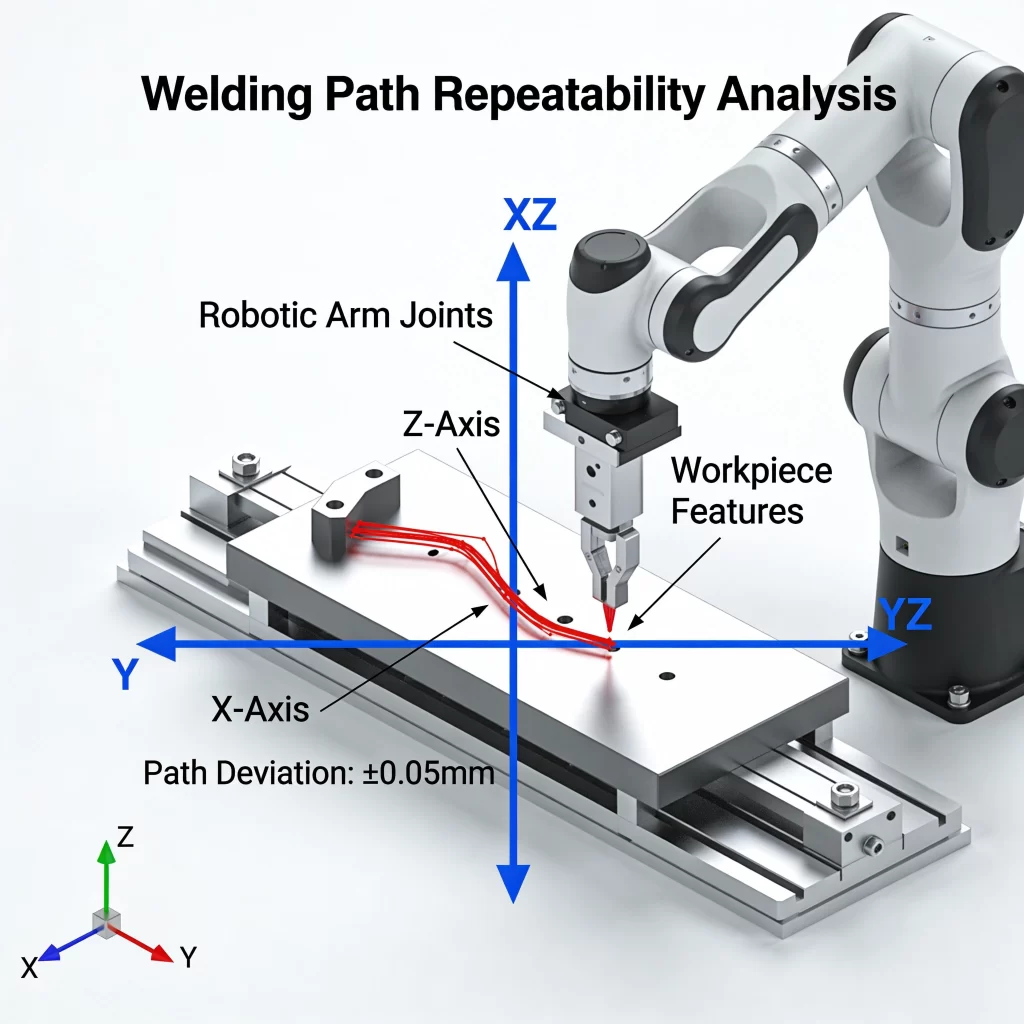
1. Welding Path Repeatability
This is the first metric we use to evaluate stability. In batch production, the robot must weld in exactly the same position every time. Even a deviation as small as 0.1 mm can become a significant issue when multiplied across hundreds or thousands of parts. Whether the welding path can be reliably repeated often determines whether a process is suitable for mass production.
2. Heat Input Stability
Even with an accurate path, fluctuations in current, voltage, or welding time can lead to inconsistent weld formation and strength, increasing the risk of distortion or rework. Through standardized process parameters and control windows, we aim to keep these variables within an acceptable range for batch production.
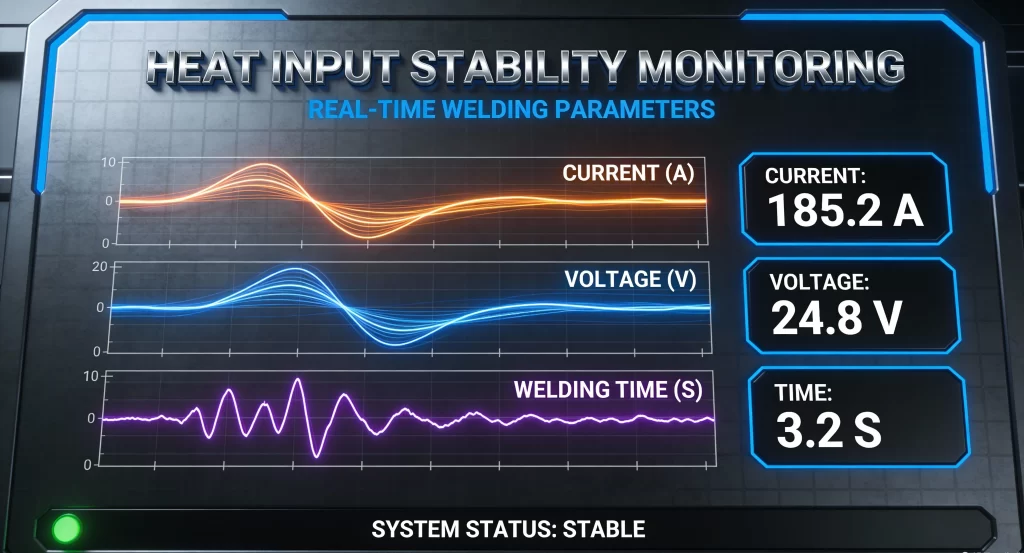
3. Consistency Monitoring During the Welding Process
Equally important is the ability to monitor and record key parameters and anomalies in real time. This allows adjustments to be made before minor issues escalate into batch-level defects. Such traceable and reviewable process control is essential for long-term stable operation.
How Intelligent Robots Improve Batch Consistency Through These Three Metrics
In practice, the value of these three metrics lies not in how advanced the technology is, but in whether they translate into stable and controllable manufacturing results. In our experience, robotic welding delivers consistent performance in batch production only when these metrics are managed together as a system.
Welding path repeatability eliminates positional deviations, ensuring that welds are consistently placed. This reduces downstream assembly adjustments and rework. In implementation, this usually requires coordination between robot accuracy, fixture stability, and, where necessary, vision or positioning systems to keep deviations within a production-ready range.
Heat input stability ensures that each weld is formed in the same way, minimizing variation in strength and appearance. When heat input is controlled, quality fluctuations across batches are significantly reduced.
Process consistency monitoring provides early warnings and traceability. By recording and analyzing data in real time, potential issues can be corrected before they spread across large production volumes.
Ultimately, the value of intelligent robotic welding lies not in the word “robot,” but in its ability to enable controlled, repeatable batch production.
Common Application Scenarios for Intelligent Robotic Welding
In our manufacturing practice, robotic welding is rarely selected based on the welding method name alone. Instead, we start by asking a more practical question: “What exactly needs to be welded?”
Just as clothing choices depend on the occasion, different products—automotive bodies, electronic components, or heavy machinery—require different welding priorities.
The table below summarizes common application scenarios from a manufacturing perspective. It is not meant to list every process, but to help quickly identify what robotic welding needs to do well in each scenario.
| Manufacturing Scenario | Typical Parts | Applicable Processes | Key Control Focus | Typical Outcomes |
| Automotive (high takt / high consistency) | Body panels, chassis, exhausts | Resistance spot welding / MIG-MAG | Stable rhythm, consistent paths, traceability | Predictable takt time, stable quality, full traceability |
| Precision electronics (low distortion / high quality) | Battery modules, PCBs, connectors | Laser welding / TIG | Precise heat control, accurate positioning, clean processes | Controlled distortion, consistent appearance, stable yield |
| Heavy equipment (thick plate / large structures) | Machinery arms, pressure vessels, wind towers | SAW / hybrid / multi-pass strategies | Consistent penetration, interpass temperature control | Uniform strength, reduced rework, stable delivery |
| Metal products (multi-variety / small batches) | Furniture, hardware, sheet metal parts | Fast MIG/MAG, TIG fill welding | Quick changeover, fixture standardization, program management | Smoother changeovers, less variation, reduced labor dependence |
| Special materials (high difficulty / high value) | Titanium medical parts, aluminum, dissimilar metals | CMT / laser-arc hybrid welding | Gas protection, HAZ control, parameter traceability | Repeatable quality, full traceability, smoother compliance |
Advantages of Robotic Welding Compared with Conventional Welding
In real manufacturing environments, we rarely debate which welding method is “more advanced.” What matters more is whether welding quality can remain at the same level during continuous delivery.
Speed — Stability of takt time matters more than raw speed.
The real advantage is not welding faster, but welding at a consistent pace. Robots can run at a stable rhythm over long periods without being affected by shifts or operator fatigue, making production planning more predictable.
Accuracy — The real impact shows up during assembly.
Manual welding deviations may seem small, but they are often magnified during assembly. Robotic welding offers superior path repeatability, resulting in more uniform part dimensions and interfaces, especially in batch production. This leads to fewer complaints and lower rework rates.
Cost — The hardest costs to control are rework and uncertainty.
In practice, unstable welding creates hidden costs: rework, material waste, downtime, and even claims. When welding becomes stable, these uncertainties decrease significantly, which is often more valuable than marginal savings in unit cost.
Safety — Stable production starts with a safer process.
Welding is inherently hazardous. Robotic welding removes operators from high-risk environments, allowing them to supervise from safe zones. Reduced safety incidents also contribute directly to production stability.
Scalability — Easier capacity planning over time.
Instead of hiring and reducing labor seasonally, robotic welding enables capacity adjustments through takt changes, additional stations, or line replication, which is more manageable in the long term.
Learning curve — Difficult upfront, easier later.
From our experience, the real challenge lies in the initial setup. Once paths, parameters, and fixtures are standardized, daily operation becomes easier and less dependent on individual skills.
Flexibility — Stability during changeovers matters most.
In today’s multi-variant, small-batch manufacturing environment, robotic welding shows its strength in stable changeovers. With proper program and fixture management, switching models is often more controlled than manual adjustment.
Future Trends and How Manufacturers Should Respond
What we see is that robotic welding is not evolving toward ever more complex systems, but toward making stability “built-in.” Whether through parameter control, process monitoring, or integration with production systems, the goal is to reduce human variability and maintain consistent results across time and batches.
For buyers, the focus is shifting from “What equipment do you use?” to “Can the results be repeated, and can issues be detected early?” Real value lies not in one-time capability demonstrations, but in validation using actual parts, measured by yield, takt stability, and long-term reliability.
From a manufacturer’s perspective, intelligent robotic welding is best understood as the ability to continuously deliver stable results. Rather than reviewing configuration lists, it is more meaningful to look at real deliveries: weld consistency, rework rates, and takt stability. In manufacturing, results that can be repeatedly verified speak louder than any equipment specification.
FAQ
Q1: What mainly determines consistency in robotic welding?
Consistency depends on welding path repeatability, heat input stability, and whether the process is monitored and traceable. Together, these ensure weld position and quality remain consistent across batches.
Q2: Why are some robotic welding projects still unstable?
Robots are execution tools. If fixtures, parameters, or program management are weak, variability is simply repeated faster. True stability comes from process design and control, not the robot itself.
Q3: Is robotic welding suitable for multi-variant, small-batch production?
It depends on whether parts share repeatable structures, require long-term production, and carry high costs of quality variation. In such cases, robotic welding often delivers greater value.
Q4: From a buyer’s perspective, what practical changes does robotic welding bring?
More predictable delivery, reduced rework, and better traceability. These benefits may not always reduce unit price, but they significantly lower risk.
Q5: What should buyers focus on when evaluating welding capability?
Rather than robot brands, focus on how consistency is ensured, how key parameters are controlled, and how anomalies are detected and handled.
Q6: Is quality inspection still necessary with robotic welding?
Yes. Robotic welding shifts risk control earlier in the process, but final inspection remains an essential part of the quality system.
Q7: Why do results vary so much between factories using robots?
The difference lies not in equipment, but in process design, fixtures, and management systems. Robots execute; processes determine outcomes.
