
 Language
Competition in overseas fireplace markets is no longer just about price. As end customers demand higher-end finishes, more customization, and stricter safety compliance, choosing the right sheet metal fireplace housing supply partner directly affects delivery reliability, rework rates, and brand reputation. For purchasing and project teams, the real challenge isn’t whether a supplier can make it—it’s whether they can deliver with a stable prototyping process, dependable lead times, a robust quality system, and complete material/compliance documentation.
What Design and Structural Requirements Are Common for Sheet Metal Fireplace Housings?
1) Safety and thermal performance: the housing must not get dangerously hot or deform
Safety comes first. We typically define surface temperature targets early, then reduce heat transfer through approaches such as double-wall construction, insulation layers, or heat shields. We also account for thermal expansion and repeated heat cycles to prevent warping, bulging, or changing gaps after the unit has been in service for a period of time.
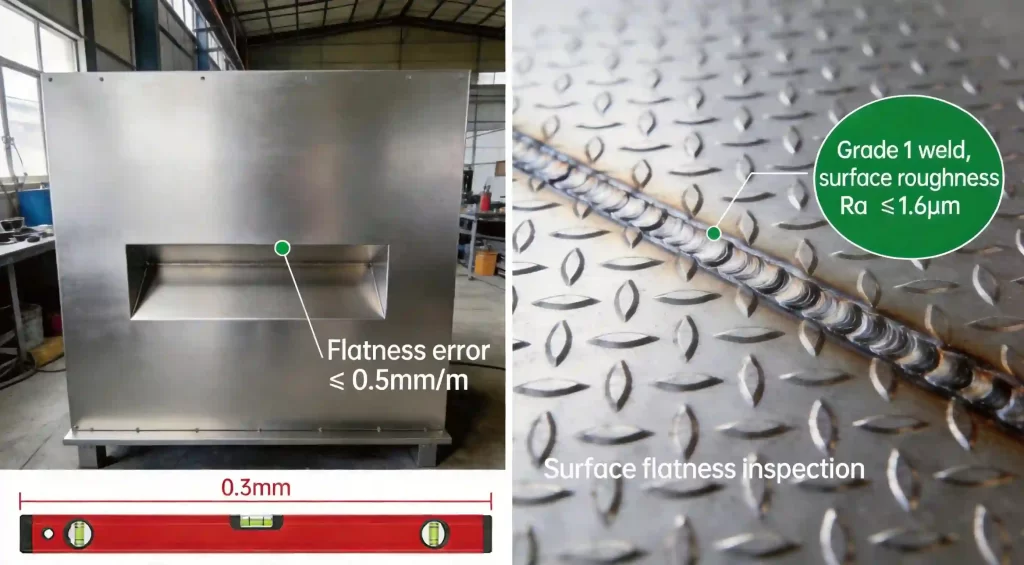
2) Structural rigidity: panels should stay flat and the assembly should feel solid
Fireplace housings often have large visible panels. With thin sheet metal, it’s easy to end up with “oil canning,” vibration, or waviness. We commonly increase rigidity with hems, flanges, and reinforcement features. High-stress areas—like door frames, hinge points, and mounting locations—need additional strengthening to avoid loosening, sagging, or noise over time.
We’ve seen this firsthand. On a floor-standing fireplace housing for an export customer, the first design had large panels and a strict flatness requirement. Without changing the exterior look, we added hidden reinforcements and optimized edge flanges. The result was noticeably better flatness and stiffness, and the appearance inspection passed on the first review.
3) Assembly consistency: holes must align and gaps should be uniform
In volume production, many buyers tell us their biggest concern is that every unit assembles the same way. That means a clear datum strategy and reliable locating features so holes, cutouts, and mating edges are consistent. Where appropriate, we allow for controlled adjustment features to make assembly smoother. For visible parts, gap and alignment control is critical—otherwise the finished units look inconsistent.
4) Appearance quality: welds, seams, and small details define the perceived value
Fireplace housings are consumer-facing products, so appearance standards are typically higher. We define A-surfaces and B-surfaces early, and we aim to place welds, fasteners, and seams out of sight. If welds are in visible areas, finishing standards (grinding, blending, cleanup) must be higher, and panel flatness needs to be managed to keep the final look clean and uniform.
5) Finish and durability: good-looking isn’t enough—stability matters
Surface finishing affects not only appearance but also corrosion resistance, scratch resistance, and long-term batch consistency. Common options include powder coating, liquid painting, and stainless steel brushing. For different markets—especially humid or coastal regions—we specify different rust-prevention and adhesion requirements. We also define finish standards early in the project to reduce back-and-forth later.
When Choosing a Sheet Metal Fireplace Housing Supplier, What Capabilities Matter Most?
1) Prototyping and engineering support
A qualified supplier should do more than build to print. During prototyping, they should confirm key requirements, flag risks early, and iterate efficiently. When prototyping runs smoothly, production is usually smoother as well.
2) Quality control and repeatability in production
Fireplace housings are appearance parts. A good prototype doesn’t guarantee stable mass production. What matters is whether the supplier has clear quality standards and repeatable process controls to consistently hold hole locations, gaps, flatness, and A-surface expectations at volume.
3) Delivery assurance: scheduling, finish control, and export documentation
Ultimately, the project succeeds or fails on delivery. We recommend prioritizing suppliers who can maintain stable production scheduling, control finish outcomes, and provide standard shipping documentation and traceability records—this reduces risk in overseas deliveries.
What Manufacturing Processes Are Common for Sheet Metal Fireplace Housings?
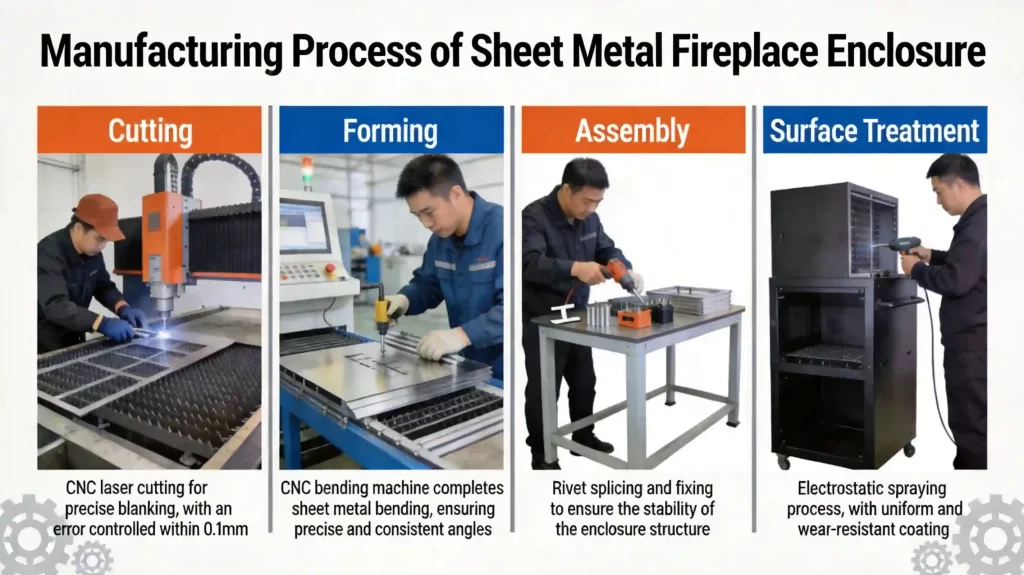
From our experience, fireplace housings typically follow a straightforward route: cutting → forming → joining & assembly → cosmetic finishing → surface finishing. We most often use laser cutting for custom work and multiple variants; for larger, stable volumes we may evaluate stamping/tooling to improve efficiency and repeatability. Forming is centered on CNC bending, with rolling used for curved geometries. For joining and assembly, we typically use welding combined with riveting or screw-based assembly to balance structural strength and assembly efficiency. Cosmetic finishing focuses on edge safety, weld cleanup, and visible-surface grading. Final appearance and durability come from powder coating, liquid painting, or stainless brushing/polishing.
For buyers, it’s not necessary to master every process detail—the key is verifying that the supplier can run this process route consistently and maintain repeatability in volume production.
The Most Common Mass-Production Risks—and How to Prevent Them Early
1) Variation between batches
In mass production, the biggest risk is loss of repeatability—gaps, flatness, and hole position can drift from batch to batch, affecting assembly and appearance. To reduce this risk, we lock critical dimensions and appearance criteria during prototyping, then execute and record them consistently in production.
2) Assembly issues scaling up
Hole fit, alignment, and door-frame issues may not show up clearly in early prototypes, but they can surface quickly once volume ramps up—leading to rework and schedule pressure. Our approach is to run a pilot build before full ramp, verifying datums, locating methods, and key mating features are truly repeatable.
3) Appearance and finish instability
Because the housing is appearance-critical, cosmetic defects and finish variation are common acceptance risks at volume. We define A/B surfaces, use reference samples or photo standards for consistent judgments, and lock finish selections and key process conditions to reduce batch-to-batch variation.
A few years ago, we had a powder-coated housing program with strict gloss and texture consistency requirements. By confirming the reference sample and formalizing appearance criteria before volume, acceptance became much more stable across later batches.
4) Delivery breakdowns
Delivery risk isn’t only about manufacturing—it also includes scheduling discipline, packaging protection, and complete shipping documentation. Any weak link can cause delays or transit damage. We mitigate this by confirming the delivery plan, packaging standards, and document checklist before mass production, then validating execution through the first shipment.
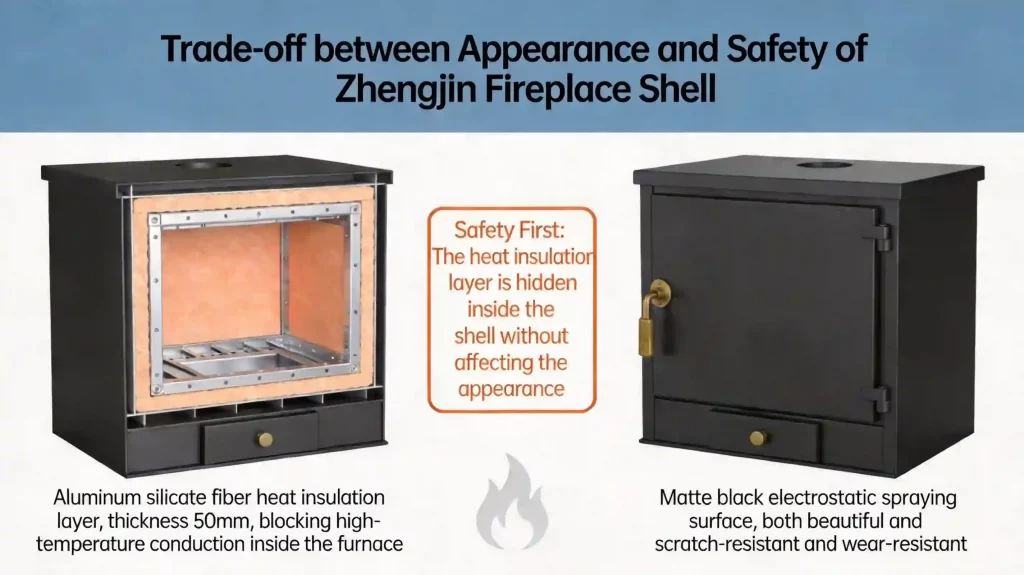
Balancing Appearance and Safety: The Key Trade-Offs in Fireplace Housing Design
1) Clean visible surfaces vs. thermal management features
Customers often want large, uninterrupted surfaces—but insulation layers, ventilation, and service openings are essential for safety and reliability. We prioritize thermal performance first, then use structural masking, hidden cutouts, or optimized vent placement to preserve a clean look.
2) Tight gaps vs. tolerance for heat and distortion
Smaller door gaps and seam gaps look more premium, but thermal expansion and weld distortion make tight gaps harder to control in volume. We set a realistic spec range and improve repeatability through a consistent datum strategy and locating features rather than chasing extreme gap targets.
3) Hidden fasteners vs. serviceability
Hidden fasteners improve visual continuity, but overdoing it can hurt service access and raise after-sales costs. Our principle is to hide fasteners on visible areas while preserving practical service points where disassembly is required.
4) “Invisible welds” vs. cost and production efficiency
Everyone prefers welds not to show, but welding methods affect structural strength, distortion control, and cycle time. We ensure joint integrity first, then manage weld visibility through weld placement, seam planning, and a defined appearance grade—balancing aesthetics with manufacturability.
How Surface Finishing Affects Appearance and Durability
In our view, surface finishing doesn’t just determine color, gloss, and texture—it directly impacts batch-to-batch consistency, which is crucial for appearance parts. Durability (scratch resistance, wear resistance, and corrosion resistance) depends not only on whether you choose powder coating, paint, or stainless brushing, but also on pretreatment quality and process control. In humid or coastal environments, those differences are amplified. For areas near the heat source, we also evaluate thermal stability to reduce the risk of discoloration or aging. Because finishing is a common source of production variation, we typically confirm a reference sample and lock acceptance criteria before mass production to reduce rework and schedule risk.
From Prototype to Mass Production: How to Keep the Project on Schedule
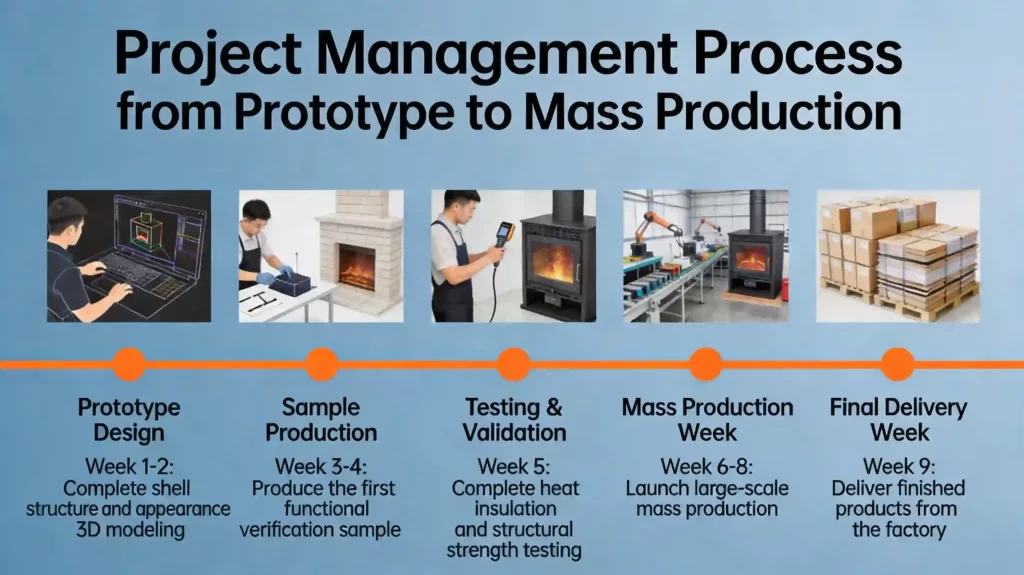
To keep a project on schedule from prototyping through mass production, we follow a simple delivery logic: lock requirements and standards during prototyping, validate that those standards can be repeated at pilot volume while running through QC, assembly, packaging, and export documentation, then enter mass production with a fixed process route, fixed acceptance criteria, controlled change management, and disciplined scheduling. When each milestone is “confirmable, repeatable, and deliverable,” lead times become far more predictable.
Conclusion
Choosing a sheet metal fireplace housing supplier is essentially choosing a repeatable delivery system—not just a one-time manufacturing capability. In our projects, on-time delivery typically comes down to four factors: aligning requirements and locking standards during prototyping, maintaining dimensional and cosmetic repeatability in mass production, controlling finish variation between batches, and managing the full delivery chain (scheduling, packaging, and documentation). When standards are set early, pilot builds validate repeatability, and production runs with stable processes and controlled changes, both lead time and quality become far more predictable—and long-term collaboration becomes much easier.
FAQ
Q1: What information should we include in an RFQ?
2D/3D files (STEP preferred), fireplace type/heat-source location, A-surface definition and appearance expectations, finish targets, assembly method, and key mating dimensions.
Q2: Why can a prototype pass but production still vary?
Most often because critical dimensions, appearance acceptance criteria, and production inspection methods were not formally locked during the prototype phase—so there’s no single standard to reproduce at scale.
Q3: What are the most common acceptance “pain points” for fireplace housings?
Visible-surface appearance (flatness, gap uniformity, weld visibility, scratches) and finish consistency between batches (color shift, gloss/texture variation).
Q4: How do we choose between powder coating and liquid paint?
Powder coating typically favors durability and batch consistency; liquid paint is more flexible for special visual effects and complex geometry coverage. The right choice depends on appearance goals and the operating environment.
Q5: How do we reduce rework and schedule risk in mass production?
Run a pilot build before ramp, lock critical dimensions and appearance samples, fix the process route and acceptance criteria, and control changes during production.
