
 Language
Brushing is a common mechanical finishing process used in sheet metal fabrication. Abrasive belts or rotary brushes are used to create a uniform, directional grain on the stainless steel surface. This reduces specular reflection and produces a softer, matte appearance with a distinctive industrial character.
Unlike mirror polishing, which progressively removes surface texture, brushing deliberately creates a controlled grain pattern. Depending on the abrasive grit, contact pressure, and number of passes, a brushed finish typically has a surface roughness of Ra 0.1–1.6 μm. In terms of both roughness and visual refinement, it falls between mill finishes such as 2B or No. 2D and a No. 8 mirror finish.
Key Characteristics of a Brushed Finish
The most recognizable feature of brushed stainless steel is its visible parallel grain. The textured surface diffuses reflected light, resulting in significantly less glare than mirror-polished stainless steel.
Abrasives in the 80–120 grit range produce a coarse, highly visible grain. A 150–180 grit finish is commonly used for elevators, appliances, and commercial equipment. Finer abrasives in the 240–320 grit range create a more refined surface, while 400–600 grit produces a finish that approaches a satin appearance.
The directional grain also helps conceal minor scratches that run parallel to the brushing direction. Cross-grain scratches, however, remain highly visible. Repairs must therefore be carried out using the same abrasive grit and in the original grain direction.
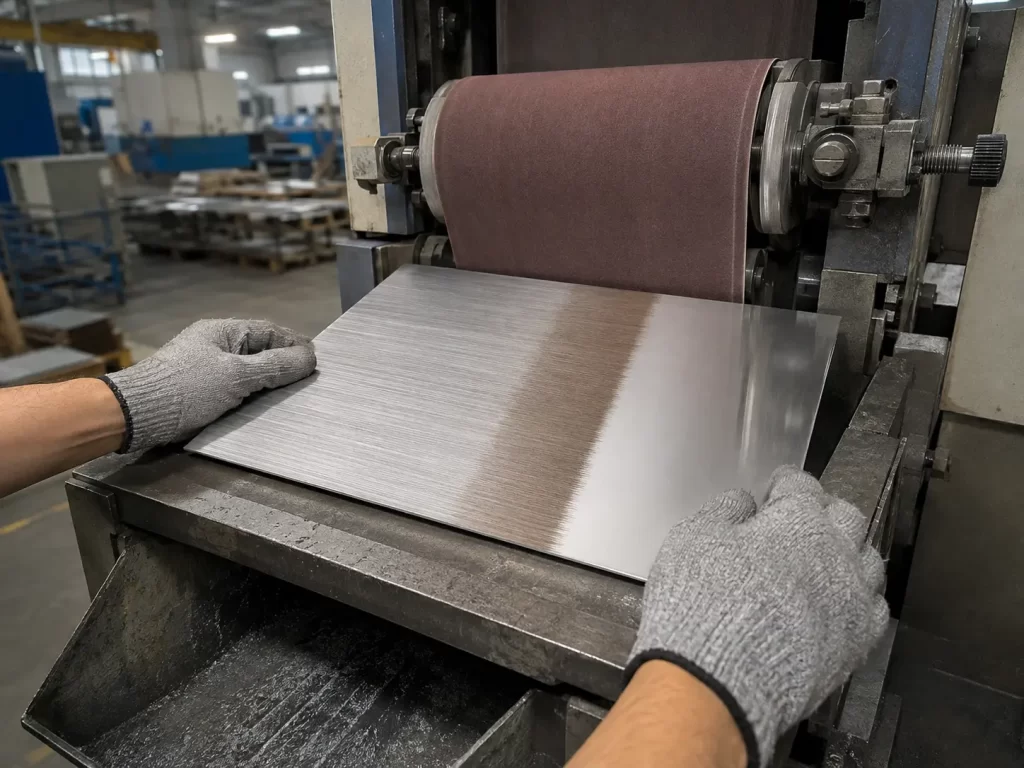
Brushed Stainless Steel Manufacturing Process
A standard brushing process usually consists of six stages:
- Surface preparation. Oil, scale, and other contaminants are removed to ensure consistent contact between the abrasive and the material surface.
- Coarse grinding. An 80–150 grit abrasive belt is used to establish the initial grain pattern, brushing direction, and baseline surface roughness.
- Fine grinding. One or more passes are made using 180–320 grit or finer abrasives to bring the Ra value within the specified range.
- Cleaning and drying. Abrasive residue, metal particles, and lubricants are removed to prevent staining and water marks.
- Passivation. Nitric or citric acid is used to remove free iron and restore the protective chromium oxide layer.
- Protective film and packaging. After inspection, a PE protective film is applied. Parts are separated using foam, dividers, or interleaving sheets to prevent surface damage.
Brushing typically removes approximately 0.01–0.05 mm of material. This material loss should be considered during tolerance planning for press-fit features, mating surfaces, and other precision components.
Ra Values and Abrasive Grit Selection
Abrasive grit is closely related to surface roughness, although belt speed, contact pressure, number of passes, and abrasive belt wear also affect the final result.
| Abrasive Grit | Typical Ra Range | Surface Appearance | Common Applications |
| 80–120 grit | 1.0–2.5 μm | Coarse, highly visible grain | Industrial enclosures, architectural panels |
| 150–180 grit | 0.5–1.0 μm | Clearly defined without appearing overly coarse | Elevators, appliances, commercial equipment |
| 240–320 grit | 0.2–0.5 μm | Fine and refined | Medical equipment, precision instruments |
| 400–600 grit | 0.05–0.2 μm | Close to a satin finish | Display cases, consumer electronics |
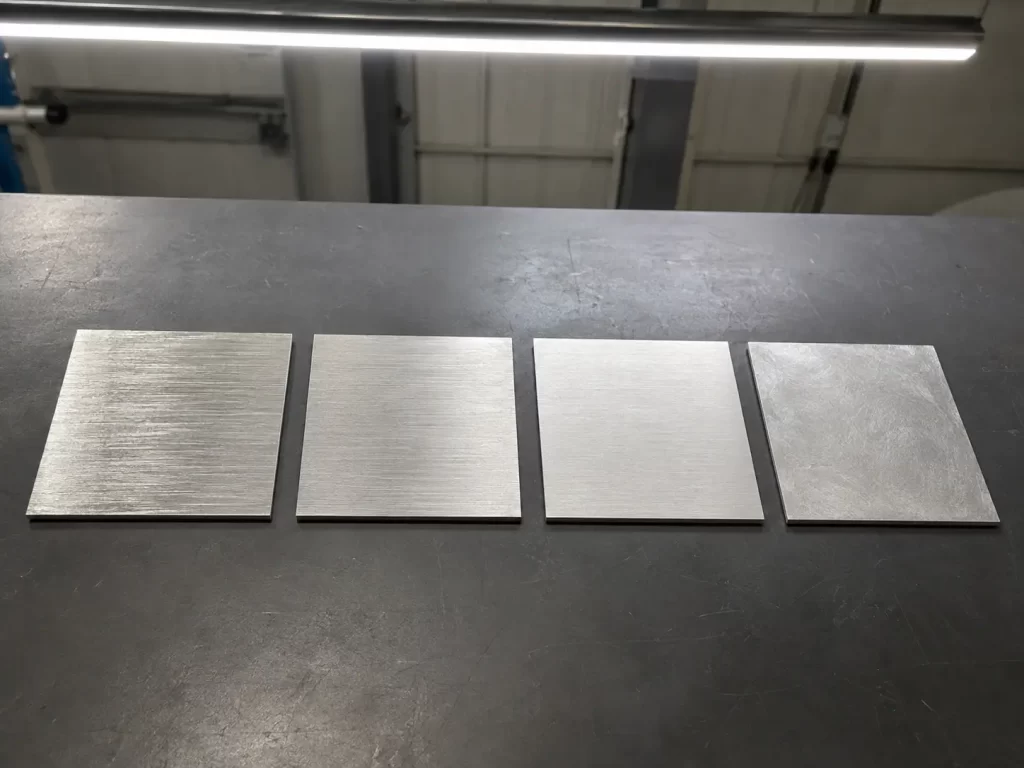
Engineering drawings should specify an Ra range rather than a single value. A requirement such as Ra 0.4–0.8 μm provides a measurable acceptance criterion while allowing for normal process variation.
Common Brushed Grain Patterns
Straight-line brushing is the most common pattern and the most suitable for volume production. The workpiece passes across the abrasive belt in one direction, producing a consistent grain at a relatively low cost.
Cross-hatch brushing uses a second perpendicular or angled pass to create a two-directional pattern. It produces a stronger visual texture but requires more processing time and carries a higher cost.
Random or vibration finishing has no dominant grain direction. It is more effective at concealing scratches from different directions, although maintaining complete consistency across high-volume production is more difficult.
Swirl and decorative finishes include circular, wave, and other specialized patterns. These are typically used for decorative purposes or to support a specific brand aesthetic.
Brushed, Satin, and Other Stainless Steel Finishes
The terms “brushed” and “satin” are often used interchangeably, but they do not describe the same finish.
A brushed finish has a clearly defined directional grain and typically falls within Ra 0.2–1.6 μm. A satin finish is usually produced using 320 grit or finer abrasives, resulting in a more uniform surface with less visible directionality and a typical roughness of Ra 0.05–0.4 μm.
Brushed finishes are better suited to applications where an industrial appearance and the concealment of scratches along the grain are important. Satin finishes are more appropriate when a softer, more uniform, premium appearance is required.
Compared with a mirror finish, brushed stainless steel has lower reflectivity, requires less maintenance, and costs less to produce. Compared with bead blasting, it has a more pronounced directional character. Compared with electropolishing, brushing is less expensive, although it does not provide the same level of cleanliness, deburring performance, or corrosion-resistance enhancement.
Selecting a Stainless Steel Grade
304 stainless steel is suitable for indoor and general-purpose products. It responds consistently to brushing and offers a balanced combination of corrosion resistance and cost.
316 and 316L stainless steel contain molybdenum, which improves resistance to pitting corrosion. These grades are better suited to outdoor, marine, food-processing, medical, and chemical environments. Because they are slightly harder than 304, brushing time is typically around 10–15% longer.
430 stainless steel is a lower-cost option for indoor, dry environments and non-critical decorative components. However, its surface consistency is generally not as reliable as that of 304.
The starting surface condition also affects processing cost. A smooth 2B finish provides an ideal base for brushing, while a No. 1 hot-rolled surface usually requires additional preparation.
Advantages and Limitations
The main advantages of a brushed finish include reduced glare, a refined appearance, effective concealment of scratches along the grain, and good repeatability across production batches.
Its limitations include greater fingerprint visibility on dark or PVD-coated surfaces, possible grain discontinuities around complex bends, deep recesses, and compound curves, minor material removal during processing, and difficulty repairing cross-grain damage. Grain direction must also be consistent across adjacent parts, as mismatched grain becomes immediately visible after assembly.
DFM Considerations
When an internal corner radius is smaller than R1.0 mm, an abrasive belt may not fully reach or conform to the surface. Dense hole patterns can produce localized unevenness, while deep grooves and narrow channels may require manual finishing or an alternative process such as bead blasting.
Sheet material thinner than 0.8 mm is more likely to deform under brushing pressure. Large panels that exceed the working width of the finishing equipment may require multiple overlapping passes, creating an additional process-control challenge.
Process sequence is equally important. Simple parts are commonly produced using a cut–brush–bend sequence because it offers the lowest cost. If the grain must remain continuous across a visible bend, a cut–bend–brush sequence may be more appropriate. Welded assemblies should be ground flush before the complete assembly is brushed.
Designers should also distinguish between visible and hidden surfaces. Applying the brushed finish only to cosmetic surfaces can significantly reduce processing cost.
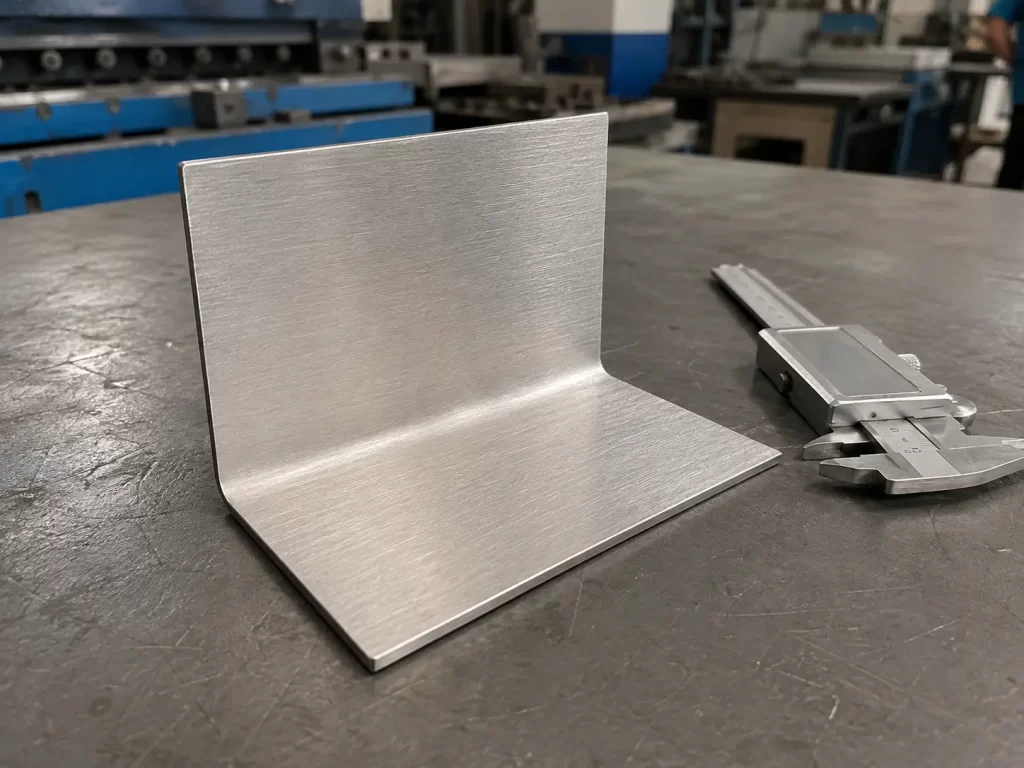
How to Specify a Brushed Finish on Engineering Drawings
A complete brushed finish specification should include:
- Surface roughness range, such as Ra 0.4–0.8 μm;
- Grain direction, such as parallel to the long edge or as indicated by an arrow;
- Applicable finish standard, such as ASTM A480 No. 4.
A recommended drawing callout is:
“Brushed finish, Ra 0.4–0.8 μm, grain parallel to the long edge, in accordance with ASTM A480 No. 4.”
A callout that states only “Brushed” or “Satin finish” does not give the supplier enough information to determine the required grain direction, roughness, or inspection criteria. This is a common source of quality disputes in stainless steel procurement.
Quality Control and Packaging
During the sample stage, Ra should be measured at a minimum of three locations: the center, the edge, and a transition area. Grain direction and overall appearance should also be verified.
In volume production, abrasive belts gradually wear and may produce higher Ra values as more parts are processed. Regular in-process inspection is therefore required, along with a defined maximum usable area for each belt.
Batch production normally uses a three-stage inspection process: first-article approval, in-process sampling, and final comparison. Before packaging, parts should be cleaned, passivated, dried, protected with film, and individually separated.
For sea freight or transportation in high-humidity conditions, moisture-resistant packaging and desiccants should also be used.
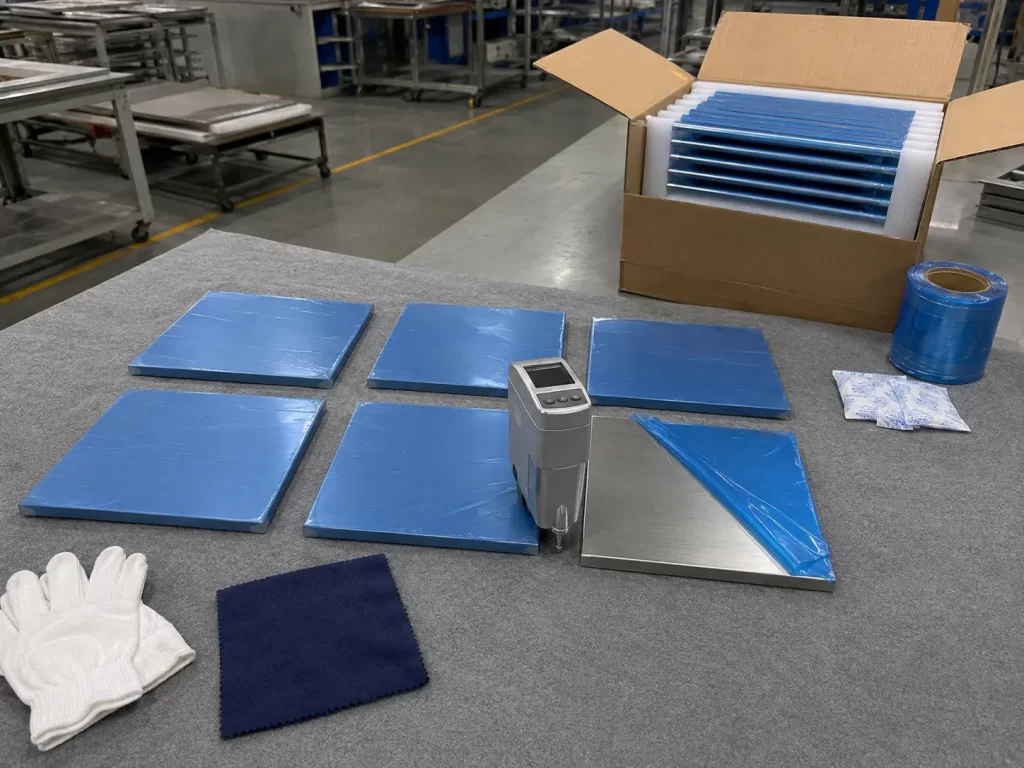
How We Support Brushed Stainless Steel Projects
We provide integrated manufacturing services covering cutting, bending, welding, hardware insertion, brushing, passivation, inspection, and export packaging.
Before production begins, we conduct a DFM review to confirm grain direction, continuity across bends and welded areas, the effect of material removal on tolerances, and the most appropriate manufacturing sequence.
For an accurate process assessment and quotation, customers should provide STEP or DWG drawings, the required material grade, sheet thickness, order quantity, Ra range, grain direction, dimensional tolerances, and packaging requirements.
Frequently Asked Questions
Does brushing reduce the corrosion resistance of stainless steel?
Brushing may cause a slight reduction in corrosion resistance. However, nitric or citric acid passivation restores the chromium oxide layer. Grade 304 is generally suitable for indoor applications, while 316 or 316L is recommended for outdoor, marine, and chemical environments.
What is the difference between brushed and satin stainless steel?
A brushed finish has a more visible and directional grain, typically within Ra 0.2–1.6 μm. A satin finish is finer, more uniform, and less directional, typically within Ra 0.05–0.4 μm.
How should a brushed finish be specified on a drawing?
The drawing should define the Ra range, grain direction, and applicable standard. For example: “Ra 0.4–0.8 μm, grain parallel to the long edge, in accordance with ASTM A480 No. 4.”
Can brushed stainless steel be welded?
Yes. After welding, the weld bead should be ground flush with the parent material before the assembly is brushed to maintain a continuous grain pattern.
Which stainless steel grade is best for brushing?
Grade 304 is suitable for indoor and general-purpose products. Grades 316 and 316L are recommended for outdoor, marine, food-processing, and medical applications. Grade 430 is a lower-cost option for indoor, dry environments.
