
 Language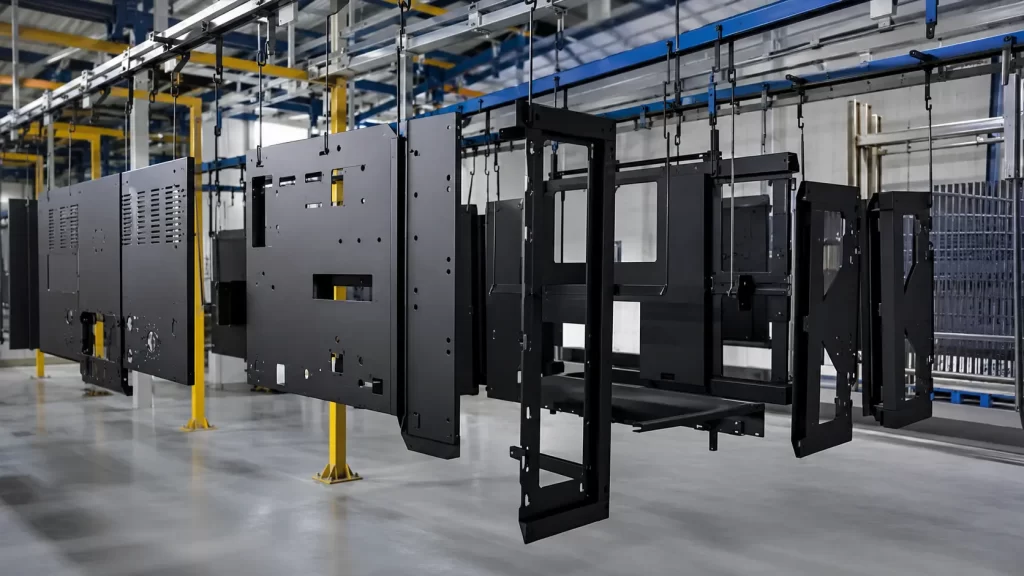
Sheet metal powder coating is a surface finishing process in which powder coating material is electrostatically applied to a metal surface and then cured with heat to form a protective coating. It is widely used for electrical enclosures, equipment housings, automation sheet metal parts, metal brackets, and OEM metal panels.
A good-looking sample only proves that the process direction is basically right. For batch production, the real test is whether the color stays consistent, whether the coating thickness affects assembly, and whether packaging and delivery can keep pace. When customers outsource this type of work, their biggest concern is usually quite practical: the approved sample looks fine, but the production batch has a color shift, or the coating builds up around threaded holes, PEM fasteners, or mating surfaces.
When we discuss this kind of project with customers, I usually start by confirming the part application. Is it a visible cosmetic part, or mainly a structural component? The answer affects how we control color tolerance, coating thickness, packaging, and lead time.
How Sample Approval Helps Maintain Powder Coating Color Consistency
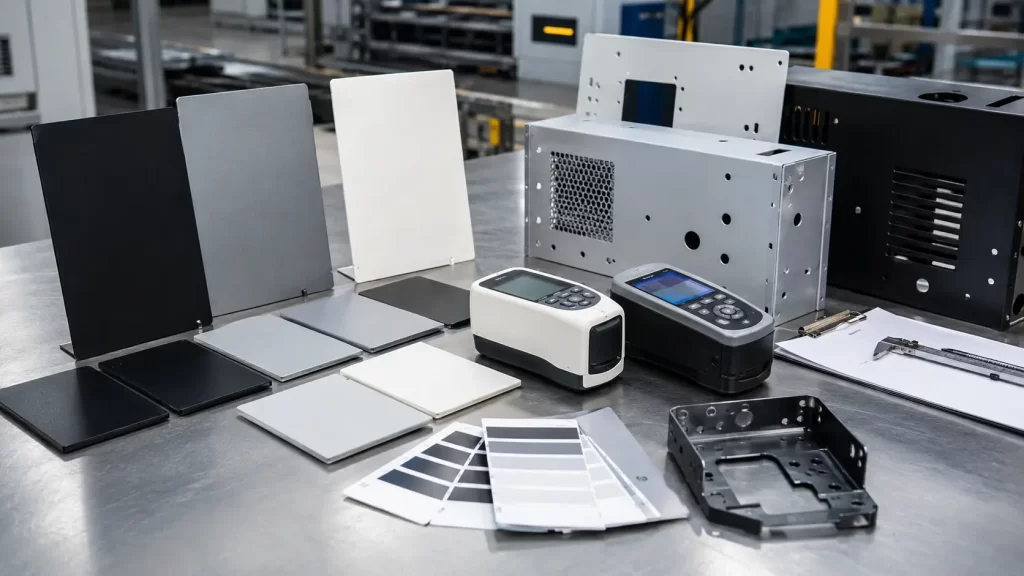
Many drawings simply state “black powder coating,” “white powder coating,” or “RAL9005.” These notes are useful, though often not enough for stable production. The same color code can look slightly different when the powder brand, coating thickness, pretreatment condition, or curing profile changes. Matte black, silver gray, and warm white are especially sensitive. Once these colors are applied to large sheet metal panels, small differences become much easier to notice.
At Baoxuan Sheet Metal Fabrication Factory, we usually recommend that customers confirm the color code, gloss level, surface texture, coating thickness range, and coating area before production. For branded equipment housings, I would also suggest approved color samples and retained first-article samples. This gives both sides a clear reference during batch production, rather than relying on vague comments like “it feels a little different.”
Gloss should ideally be measured with proper instruments. ISO 2813:2014 commonly uses 20°, 60°, and 85° geometries for coating gloss measurement. In real production, numerical gloss records are far more reliable than saying a surface should be “a little shinier” or “more matte.”
Why Powder Coating Pretreatment Affects Coating Stability
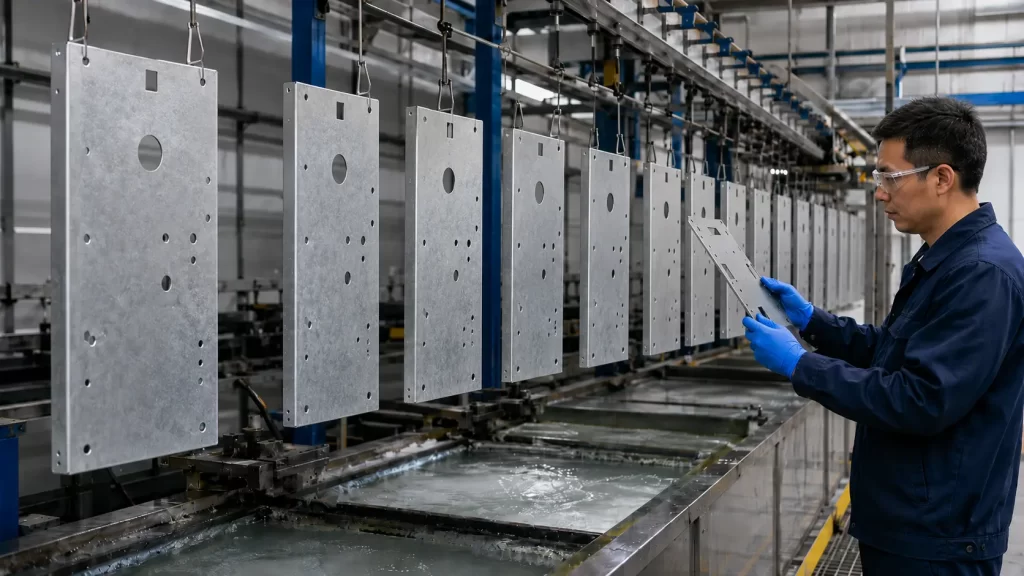
Powder coating pretreatment usually includes degreasing, cleaning, surface conversion treatment, and drying. It may sound like a basic step, but it has a direct impact on the final coating quality. If oil residue remains on the surface, the coating may blister. If weld spatter stays around the edges, the surface may show particles. If burrs are not removed properly, exposed edges or coating loss may appear after spraying.
I pay close attention to pretreatment consistency. Cold-rolled steel, galvanized steel, and aluminum alloy all have different surface conditions, so the same pretreatment approach cannot be applied blindly to every material. When Baoxuan Precision Manufacturing handles batch powder coating orders, we review polishing condition, cleaning quality, hanging method, and drying condition together. It is a detailed process, yes, but it helps prevent many problems later.
Key Controls for Coating Thickness, Adhesion, and Curing Profile
Coating thickness needs to stay within a suitable range. If the coating is too thin, hiding power and corrosion resistance may be insufficient. If it is too thick, threaded holes, slots, slide rails, and PEM nut areas may be affected. In some cases, customers report assembly problems even though the sheet metal dimensions are within tolerance. After checking, the issue turns out to be coating buildup reducing the clearance. This is more common than many people expect.
Curing should also be judged by the actual part temperature, rather than only the oven display temperature. Large cabinet doors and thick welded parts heat up more slowly. We normally look at the oven temperature profile, loading density, and part orientation to determine whether curing is sufficient. These details may seem small, but they matter a lot in high-volume delivery.
Adhesion testing can refer to ISO 2409:2020, which evaluates how well a coating resists separation from the substrate after being cut into a cross-hatch pattern. It is a practical method for process inspection and outgoing quality checks.
Comparison of Common Sheet Metal Powder Coating Service Models
| Service Model | Advantages | Potential Risks | Suitable Orders |
| Customer works directly with a powder coating shop | Flexible price negotiation | Sheet metal fabrication, coating, and packaging responsibilities may become separated | Small batches of standard structural parts |
| Sheet metal supplier coordinates an external coating partner | Smoother process coordination | Production scheduling may depend on the external coating shop | Medium or small batches of equipment parts |
| Integrated sheet metal fabrication and powder coating management | Easier coordination of color, thickness, packaging, and delivery | Requires more detailed confirmation before production | OEM housings, cabinets, and batch sheet metal parts |
| Custom high-performance powder coating | Better control over weather resistance, salt spray performance, and texture | Higher sample cost and longer approval cycle | Outdoor equipment and export projects |
According to information from the Powder Coating Institute, oversprayed powder can be recovered and reused, and overall material utilization can exceed 95%. For high-appearance color parts, however, spray booth cleanliness and color-change procedures still need strict control. Light-colored parts are especially sensitive to contamination, and even a small amount of mixed powder can become visible.
Delivery Management for OEM Batch Sheet Metal Powder Coating Orders
Stable delivery depends on clear process planning from the beginning. During drawing review, the coating area and masking locations should be confirmed. During sample approval, the color, gloss, and coating thickness should be checked. During production, fabrication, pretreatment, coating, curing, inspection, and packaging all need to connect smoothly.
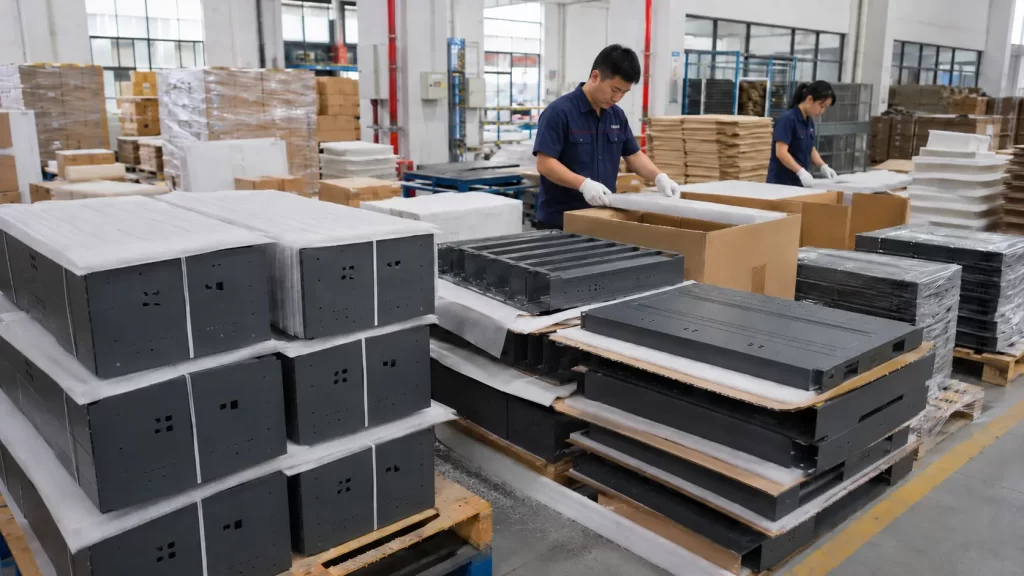
At Baoxuan Metal Fabrication Factory, we keep batch traceability records, inspection records, and packaging photos for OEM orders. If a customer needs to trace a specific batch later, the information can be matched more quickly. Powder coating work becomes much more stable when requirements are clearly defined at the beginning.
FAQ
What should buyers check when sourcing sheet metal powder coating services?
It is worth checking whether the supplier has sample approval, coating thickness inspection, gloss measurement, adhesion testing, batch traceability, and protective packaging capability. Unit price matters, but it should not be the only factor.
What should be done if the powder coating color is inconsistent?
Start by checking the powder batch, coating thickness, curing profile, gloss level, and possible packaging friction. Then compare the parts against the approved sample. Photos can be affected by lighting, so physical samples are usually more reliable.
Is a thicker powder coating always better?
The right thickness depends on the part application. Structural parts need assembly clearance, while cosmetic parts need hiding power and surface quality. Coatings that are too thick or too thin can both create problems.
Why do orange peel, pinholes, or exposed edges appear after powder coating?
Common causes include poor pretreatment, moisture in the powder, unstable spray distance, insufficient edge coverage, or improper curing conditions. The issue usually needs to be checked from material, process, and production management together.
Can batch orders be delivered in several shipments?
Yes. For visible parts used on the same finished product, it is better to use parts from the same coating batch whenever possible. This makes color consistency easier to control.
Choosing a Stable Sheet Metal Powder Coating Supplier Supports Long-Term Cooperation
Sheet metal powder coating is a finishing process, but it directly affects product appearance, assembly experience, and customer acceptance after delivery. For batch sheet metal powder coating, equipment housings, or OEM surface finishing projects, you can send the drawings, color code, approved sample, and estimated annual demand. Once the process requirements are clarified early, production planning becomes much smoother.
