
 Language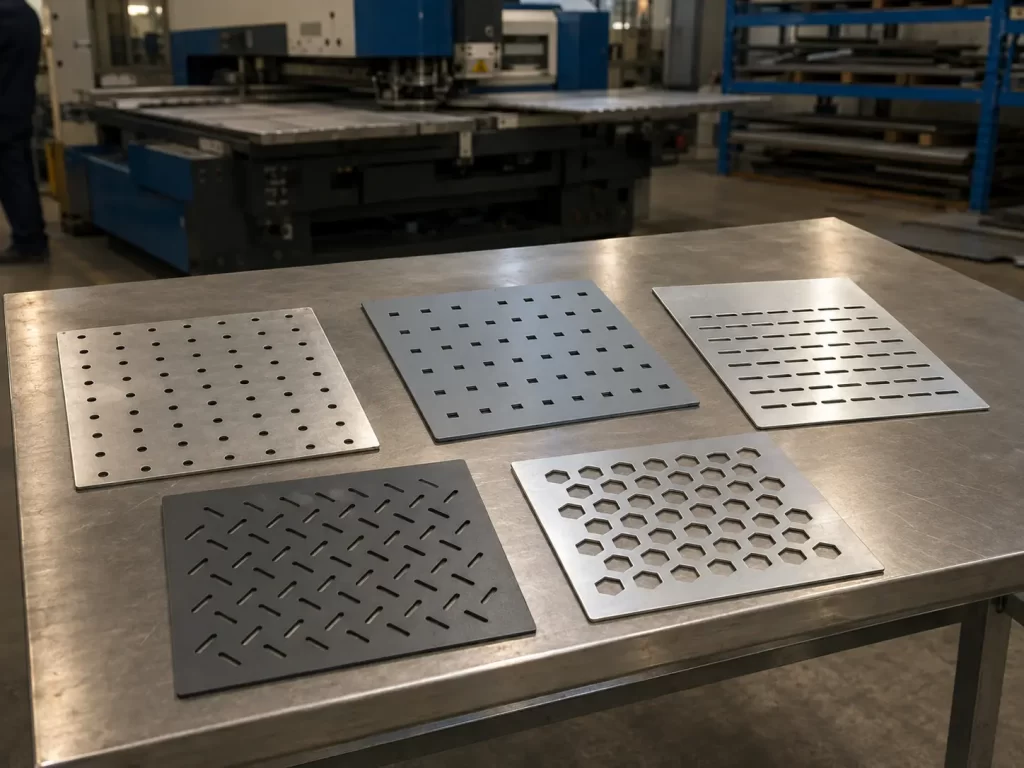
What Is CNC Punching for Perforated Sheet Metal Parts?
What Are Perforated Sheet Metal Parts?
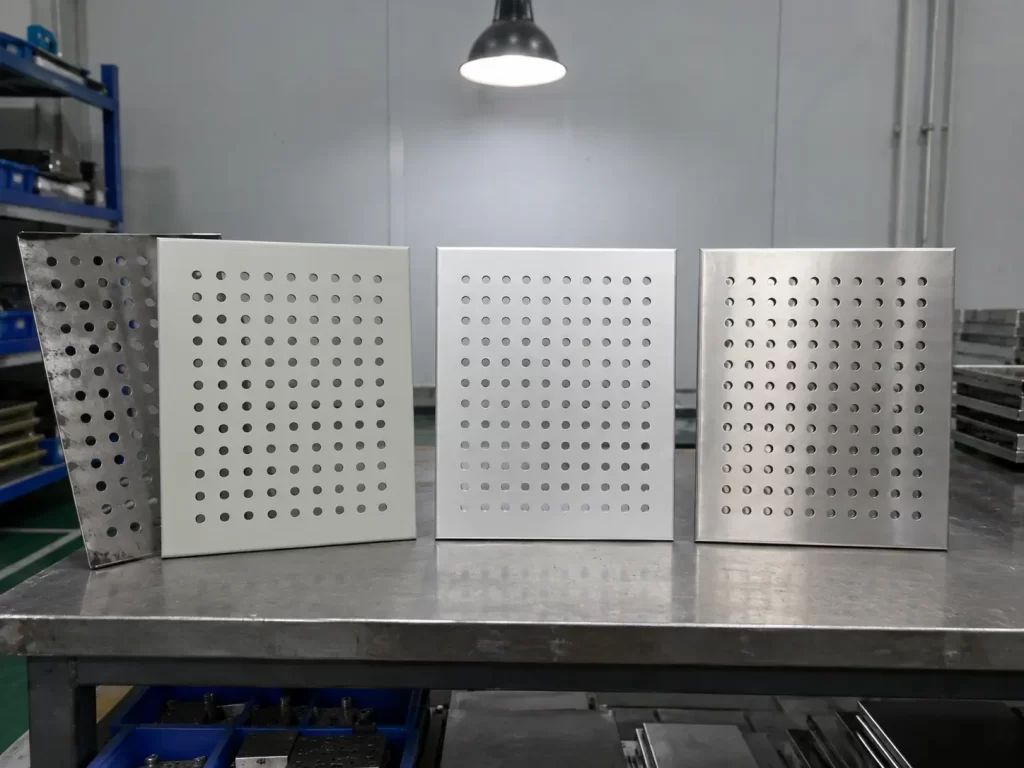
Perforated sheet metal parts are flat metal components with a pattern of holes, slots, or custom-shaped openings. These features are commonly used for ventilation, filtration, noise control, visual screening, and weight reduction.
Unlike expanded metal or woven wire mesh, perforated sheet metal starts as a solid sheet. Material is removed only where the openings are required, so the areas between the holes retain the original sheet thickness.
CNC Punching vs. Other Cutting Methods
CNC punching is mainly used for high-speed hole production in thin to medium-gauge sheet metal. The most suitable process depends on hole size, sheet thickness, pattern complexity, and order volume.
| Process | Typical Applications | Main Advantages |
| CNC Punching | 0.5–6.0 mm sheet metal | Fast and cost-effective for standard hole patterns and medium-to-high volumes |
| Laser Cutting | Thin to medium-thickness sheet | Well suited to small holes, custom shapes, and complex patterns |
| Plasma Cutting | Thick plate | Suitable for larger openings and profiles |
| Waterjet Cutting | Wide range of thicknesses | No significant heat-affected zone, but relatively slow |
| Nibbling | Thin sheet metal | Suitable for certain irregular profiles |
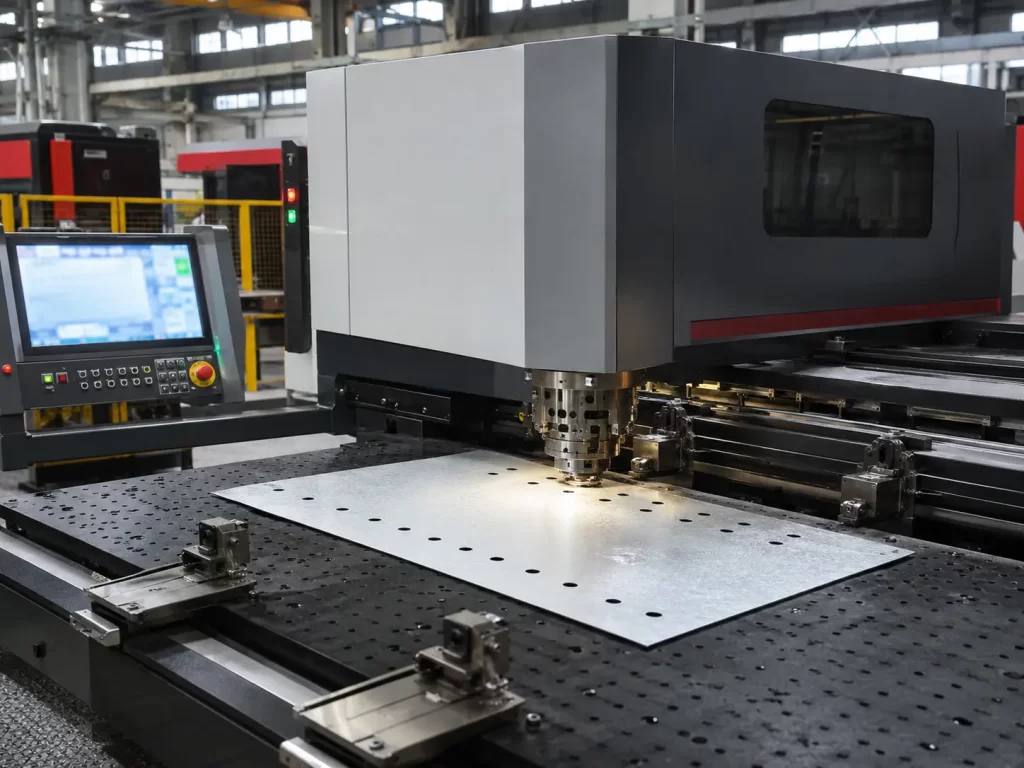
For standard round holes, square holes, and slots, CNC punching usually offers strong production efficiency and a competitive unit cost when order quantities are relatively high.
For small holes, complex shapes, or low-volume prototypes, laser cutting is often the more flexible option.
Which Materials Are Best Suited to CNC Punching?
Common materials include stainless steel, aluminum, carbon steel, galvanized steel, copper, and brass.
| Material | Common Grades | Main Characteristics |
| Stainless Steel | SUS304 / 316 | High strength and good corrosion resistance |
| Aluminum | 5052-H32 / 6061 | Lightweight and corrosion-resistant |
| Carbon Steel | SPCC / SPCD | Cost-effective and easy to process |
| Galvanized Steel | SGCC | Good balance of cost and corrosion protection |
| Copper / Brass | C110 / C260 | Good electrical and thermal conductivity |
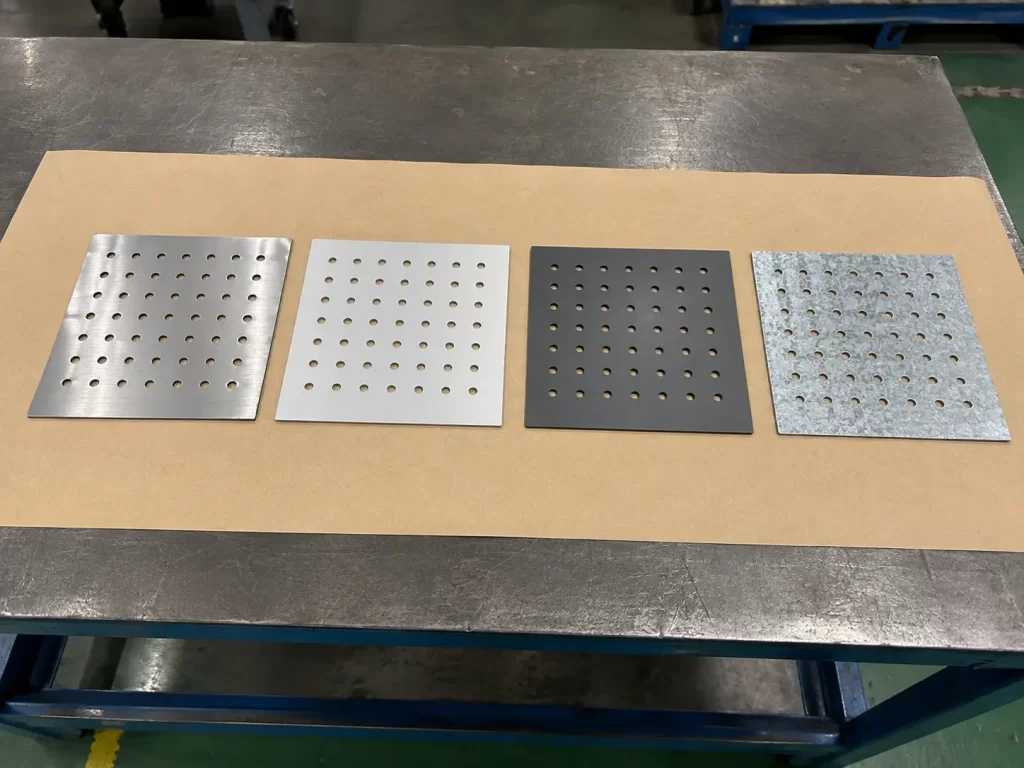
Material selection affects not only the performance of the finished part, but also punching force and tool life.
At the same thickness, stainless steel generally requires greater punching force and causes faster tool wear. Aluminum is softer, but large areas with dense hole patterns are more prone to distortion.
For this reason, material, sheet thickness, and hole pattern should always be considered together.
Which Design Parameters Should Engineers Specify?
Hole Size and Sheet Thickness
The relationship between hole diameter and sheet thickness is one of the most important considerations in CNC punching.
As a general rule, the hole diameter should be at least 1.2 times the sheet thickness. For production runs, a ratio of 1.5 times the sheet thickness or greater is preferred whenever possible.
This helps maintain cleaner hole quality and reduces the risk of damage to small punches.
If the required hole diameter is significantly smaller than the sheet thickness, laser cutting is usually a better option.
Hole Spacing and Edge Distance
Several dimensions should be reviewed when designing perforated sheet metal.
· Center-to-center spacing
The distance between the centers of adjacent holes. If the spacing is too small, the material between the holes may deform.
· Web width
The amount of material remaining between adjacent holes. As a general guideline, it should not be smaller than the sheet thickness.
· Edge distance
The distance from the center of the outermost hole to the sheet edge. Insufficient edge distance can lead to distortion or cracking during punching.
Open Area
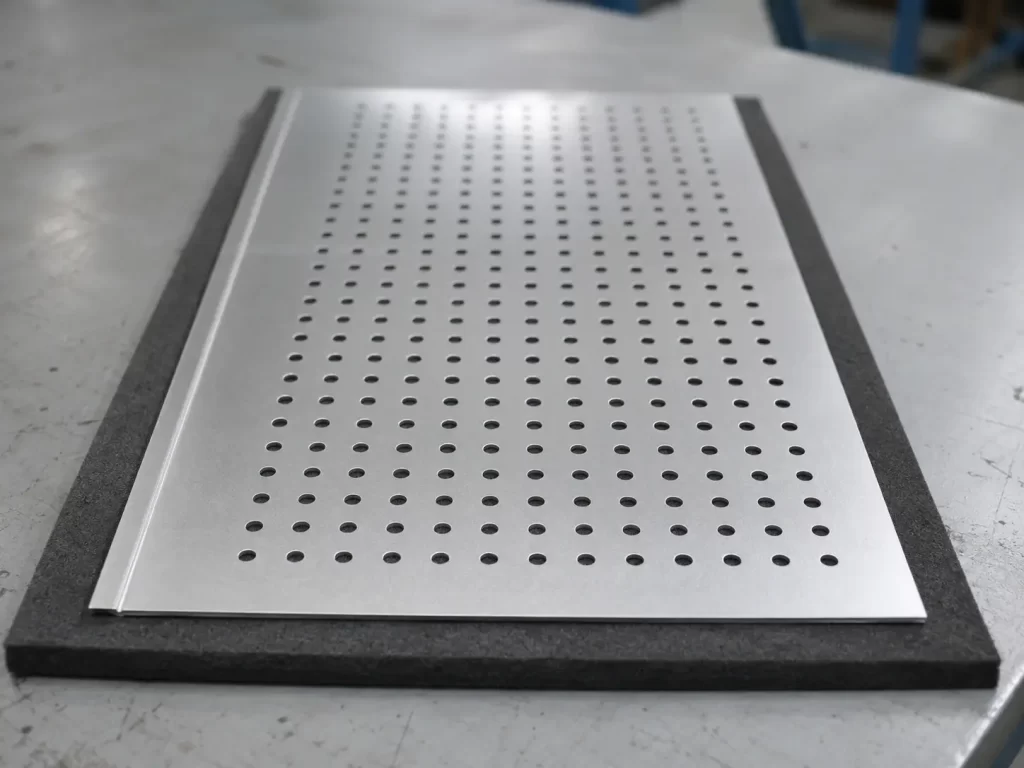
Open area refers to the percentage of the sheet surface occupied by holes.
A higher open area generally improves airflow and visibility, but it also reduces panel stiffness.
For parts that carry loads or require subsequent bending, the design should not focus on open area alone. Hole shape, spacing, load direction, and bend location must also be considered.
For structurally important parts, the design should be evaluated based on the actual loading conditions.
Design Reference
| Sheet Thickness | Recommended Minimum Hole Diameter | Suggested Minimum Edge Distance |
| 0.5 mm | 0.8 mm | 1.5 mm |
| 1.0 mm | 1.5 mm | 2.5 mm |
| 1.5 mm | 2.3 mm | 4.0 mm |
| 2.0 mm | 3.0 mm | 5.0 mm |
| 3.0 mm | 4.5 mm | 7.0 mm |
These values are intended as general design references. Final dimensions should still be confirmed based on material, tooling, and part geometry.
Which Design Features Make CNC Punching More Difficult?
The following features can increase the difficulty of CNC punching.
Very small holes
Small punches wear more quickly and are more likely to be damaged.
Insufficient spacing between holes
The material between holes may distort or tear.
Small edge distances
The sheet edge may become visibly distorted.
Very high open area
The sheet loses stiffness and becomes more prone to warping.
Large numbers of custom-shaped holes
Special punches may be required, increasing tooling costs.
Multiple hole types in one part
More tooling stations may be needed, which can increase cycle time.
Dense perforation over a large area of thin sheet
This can increase the risk of waviness and flatness problems during punching.
How We Review Drawings for Manufacturability
We review each punching drawing for manufacturability before quoting.
First, we check whether the required hole sizes and shapes can be produced using standard tooling. We then review hole spacing, edge distance, and open area in relation to the specified material and sheet thickness.
If the part also requires bending, welding, or surface finishing, we check whether the perforated areas could interfere with those downstream operations.
This early review helps identify issues that may increase tooling costs, cause sheet distortion, or create assembly problems before the part reaches the prototype stage.
What Surface Finishes Are Available?
Common finishing options for perforated sheet metal parts include the following.
Powder Coating
Suitable for carbon steel, galvanized steel, and aluminum. It provides a durable finish with a wide range of color options.
Anodizing
Primarily used for aluminum. It improves corrosion resistance and surface hardness.
Electroplating
Zinc and nickel plating are common options for improving corrosion resistance or specific surface properties.
Passivation
Primarily used for stainless steel to enhance corrosion resistance.
Surface finishing can also affect hole dimensions. Powder coating, in particular, adds coating thickness to the hole walls and slightly reduces the finished hole diameter.
If a hole is used for screws, bushings, or other precision-fit components, the required finished dimension should be clearly specified on the drawing.
Where Are CNC-Punched Perforated Parts Used?
Ventilation and Airflow Management
Electrical cabinets, server racks, HVAC equipment, and machine enclosures often use perforated panels for cooling and airflow control.
Filtration and Separation
Perforated metal is widely used for industrial filtration, screening, and material separation. Hole size and open area should be selected according to particle size and flow requirements.
Acoustic Control
Machine enclosures and ventilation silencers often combine perforated panels with sound-absorbing materials to reduce operating noise.
EMI/RFI Shielding
Electronic enclosures can use carefully designed perforation patterns to provide ventilation while maintaining a degree of electromagnetic shielding.
Architectural and Decorative Applications
Perforated aluminum and stainless steel panels are commonly used for façades, partitions, ceilings, and decorative panels. These applications often place greater emphasis on hole consistency, flatness, and surface appearance.
How Should You Prepare an RFQ for Perforated Sheet Metal Parts?
A complete RFQ reduces unnecessary back-and-forth and helps the supplier provide a more accurate quotation.
We recommend including the following information.
| Information | Why It Matters |
| 2D Drawings and 3D Files | Defines dimensions and part geometry |
| Material Grade | Determines material cost and processing conditions |
| Sheet Thickness | Affects tooling selection and punching force |
| Hole Size and Pitch | Helps determine manufacturing feasibility |
| Order Quantity | Influences production method and unit cost |
| Surface Finish | Defines downstream processing requirements |
| Tolerance Requirements | Determines the required inspection approach |
| Target Lead Time | Helps with material procurement and production planning |
If the part has special requirements for flatness, burr direction, cosmetic appearance, or packaging, these should also be stated at the RFQ stage.
How We Support Your Perforated Sheet Metal Project
We provide CNC punching services for perforated sheet metal parts from prototype quantities through volume production.
Before quoting, our engineering team reviews the material, sheet thickness, hole size, hole spacing, and hole pattern. We also consider any downstream requirements such as bending, welding, and surface finishing.
We work with carbon steel, stainless steel, aluminum, copper, and galvanized steel, and can support both standard and custom hole patterns.
If you already have 2D drawings or 3D files, you can send them together with the material grade, sheet thickness, quantity, surface finish, and target lead time. We can then assess whether CNC punching is the most suitable manufacturing method for your part.
Frequently Asked Questions
What is the minimum hole size for CNC punching?
As a general rule, the hole diameter should be at least 1.2 times the sheet thickness. For production runs, a ratio of 1.5 times or more is preferred for better hole quality and longer tool life.
What is the difference between CNC punching and laser cutting?
CNC punching is better suited to standard hole patterns and medium-to-high-volume production. Laser cutting is more flexible for small holes, custom shapes, and complex patterns.
Is a higher open area always better?
No. A higher open area can improve airflow, but it also reduces sheet stiffness and increases the risk of distortion.
Does punching reduce sheet metal strength?
Yes. Perforations reduce the effective load-bearing area of the sheet. Load-bearing parts should therefore be designed with appropriate hole patterns, spacing, and open area.
What information should I provide when requesting a quote for perforated sheet metal parts?
Ideally, provide drawings, material grade, sheet thickness, hole size, hole spacing, quantity, surface finish, tolerance requirements, and target lead time.
