
 Language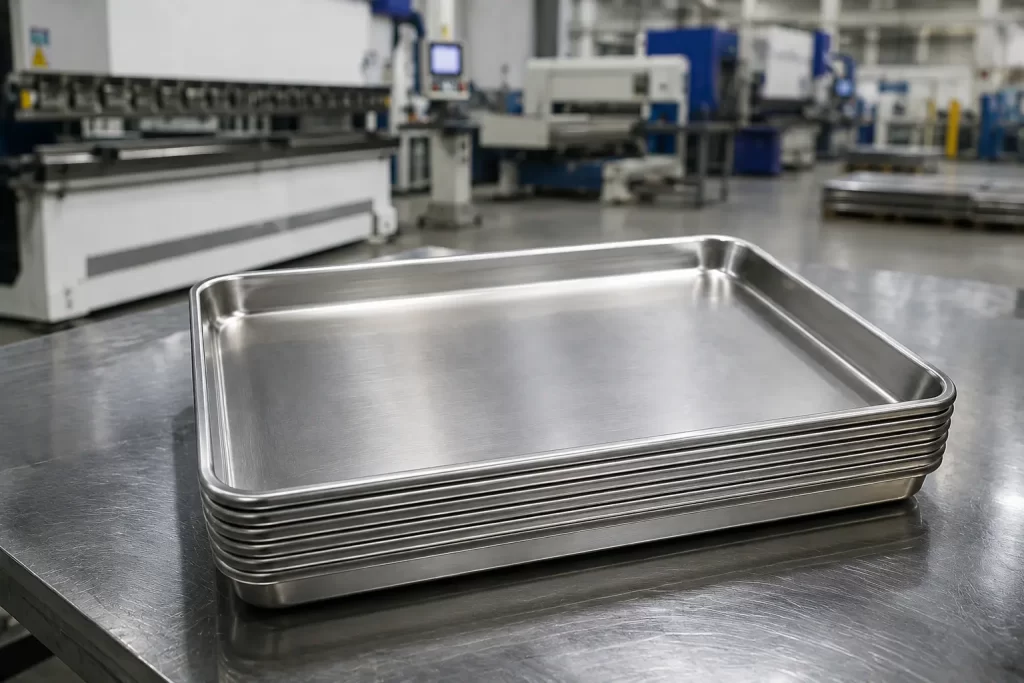
Sheet metal baking tray fabrication involves transforming flat metal sheets into finished baking trays through processes such as laser cutting, bending, welding, and surface finishing. For food-grade baking trays, product quality depends not only on machine precision, but also on material consistency, engineering design, and overall process control.
Over the years, I’ve noticed that many customers focus first on price and lead time. In reality, though, the long-term quality of a baking tray is usually determined much earlier in the process. Once the wrong material or process setup is chosen, later rework can only fix so much.
Common Materials Used for Baking Tray Fabrication
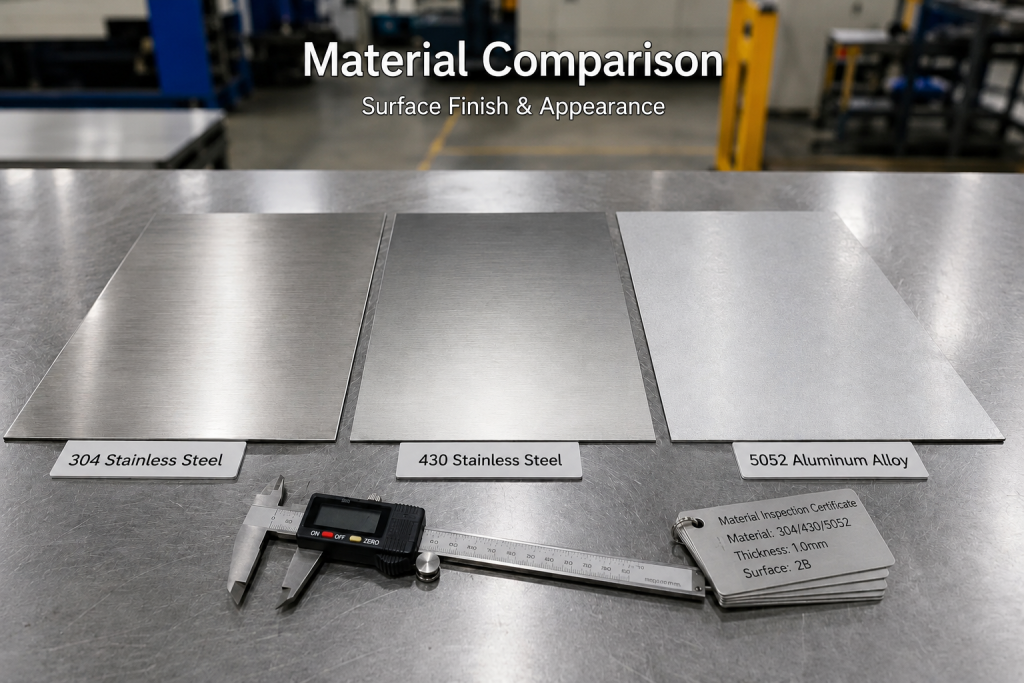
The most widely used materials for baking trays are 304 stainless steel, 430 stainless steel, and 5052 aluminum alloy. Among them, 304 stainless steel remains the preferred option for food-grade applications because it offers a strong balance of corrosion resistance and formability.
430 stainless steel is more cost-effective and is commonly used in lower-cost household products, but its corrosion resistance is noticeably weaker than 304 stainless steel, especially in high-temperature or acidic environments. Meanwhile, 5052 aluminum alloy is often chosen for lightweight industrial baking trays thanks to its low weight and fast heat transfer properties.
In actual production, material consistency matters just as much as material grade. Even when two suppliers both provide “304 stainless steel,” the forming performance can vary significantly. I once handled a project where the customer supplied their own material. Although the chemical composition technically met the standard, the sheet cracked much more easily during bending, and the entire batch had to be reworked.
Because of situations like this, many food-grade sheet metal projects now include incoming material inspections such as spectrometer analysis, thickness checks, and surface quality verification before production begins.
| Material | Corrosion Resistance | Formability | Typical Applications | Cost |
| 304 Stainless Steel | Excellent | Good | Commercial and premium baking trays | Higher |
| 430 Stainless Steel | Moderate | Fair | Household and entry-level baking trays | Medium |
| 5052 Aluminum Alloy | Good | Excellent | Lightweight industrial baking trays | Medium to high |
Why Drawing Review and Flat Pattern Calculation Matter
Baking trays are essentially box-shaped sheet metal parts, which means dimensional accuracy depends heavily on proper flat pattern calculations. If production starts without a detailed engineering review, problems such as dimensional mismatch, welding misalignment, or part distortion can easily occur later in the process.
For example, when working with 0.8 mm 304 stainless steel, the K-factor is typically controlled between 0.35 and 0.40. However, tooling setup and die opening size can still affect the final flat dimensions. Once bending tolerances accumulate across four sides, even a small calculation error can lead to visible diagonal deviation in the finished tray.
That’s why most professional manufacturers perform a DFM (Design for Manufacturability) review before cutting begins. Bend sequence, weld allowances, and inside bend radii are all checked in advance to reduce production risks and avoid costly rework later.
How Laser Cutting Affects Downstream Quality
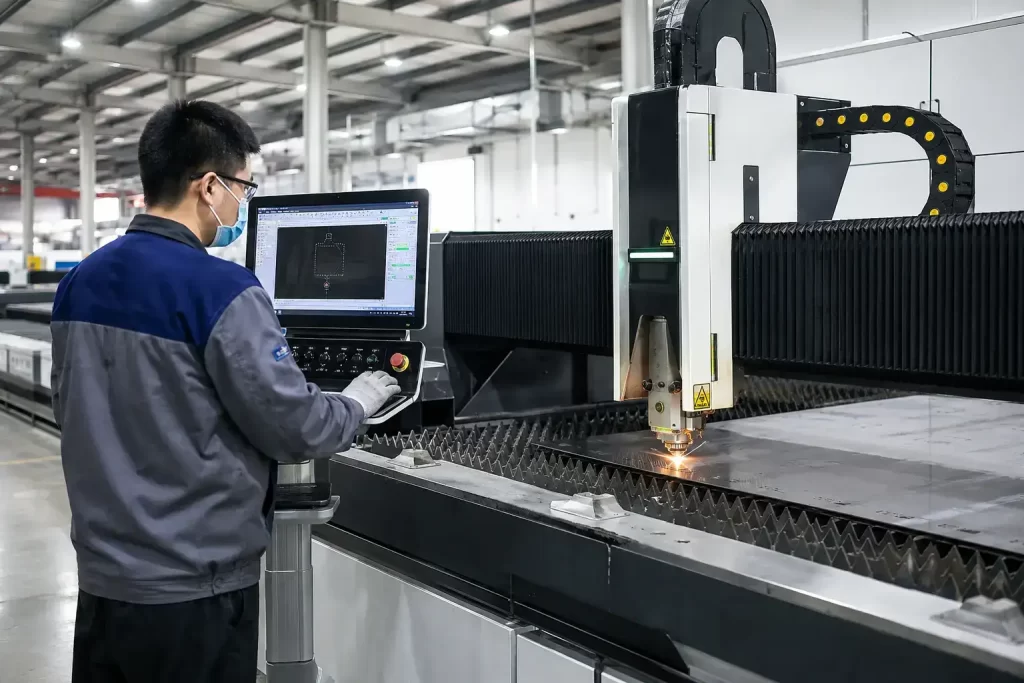
Laser cutting is the core blanking process in baking tray fabrication because it directly impacts bending accuracy and welding consistency. Today, fiber laser systems have largely replaced traditional CO₂ lasers for thin stainless steel processing.
For stainless steel trays ranging from 0.5 mm to 1.5 mm thick, manufacturers commonly use fiber lasers in the 3000W to 6000W range. This power level provides a good balance between cutting speed and edge quality.
Assist gas selection is equally important. High-pressure nitrogen is typically used when cutting stainless steel because it minimizes oxidation and improves edge smoothness. If gas pressure is too low, burrs and slag can form along the cut edge, increasing post-processing time and affecting product appearance.
Part nesting layout also matters. When thin sheet parts are placed too closely together, heat concentration can cause localized warping, especially during high-volume production runs.
Bending and Welding Define the Final Product Quality
Stainless steel naturally produces springback during bending, so bend parameters usually need adjustment before mass production starts. For 0.8 mm 304 stainless steel, a 90-degree bend may spring back by around 3 to 5 degrees.
Some people see test bending as wasted material, but in practice, it is a necessary step for ensuring production consistency. Skipping this stage often leads to much higher rework costs later.
TIG welding is commonly used for joining baking tray corners because it creates cleaner welds with less distortion. After welding, the joints are typically ground and blended to achieve a smooth, uniform surface finish. For food-grade products, weld quality affects not only structural strength but also cleanliness and overall appearance.
Surface Finishing and Quality Control Cannot Be Overlooked
Electropolishing is one of the most common surface finishing processes for food-grade baking trays. It reduces surface roughness, improves cleanability, and helps minimize food residue buildup during use.
For export products, manufacturers also need to consider compliance with food-contact regulations such as EU Regulation EC No 1935/2004. In many cases, these requirements influence material selection from the very beginning of the project.
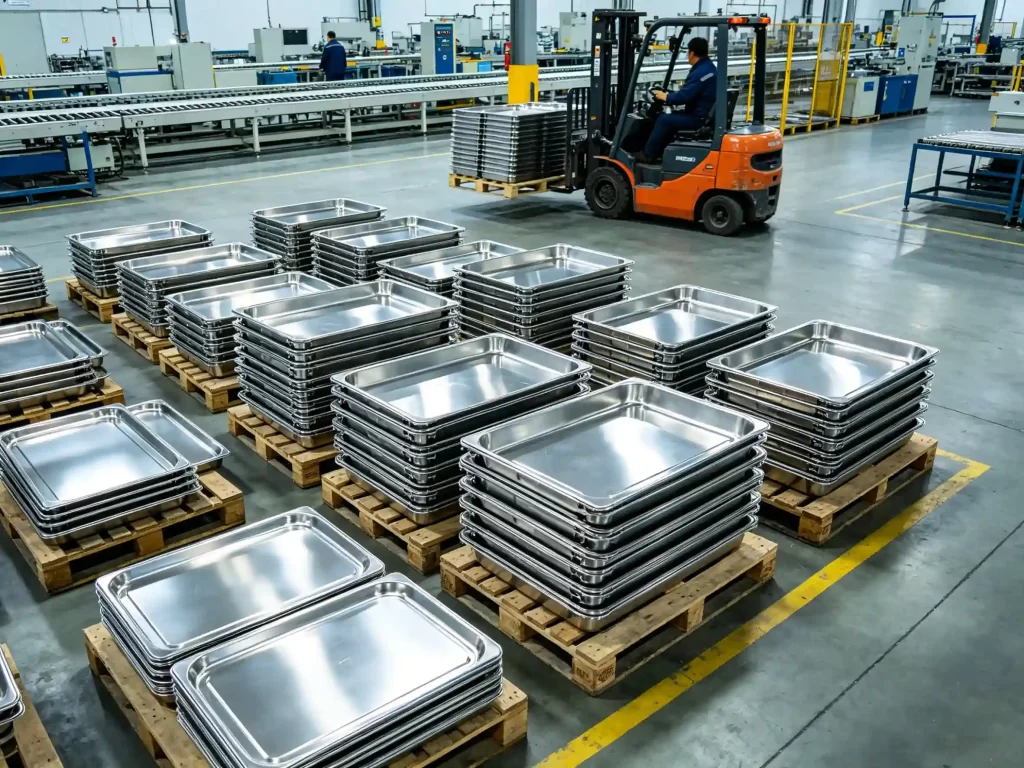
In addition to surface finishing, consistent quality control throughout production is essential. Typical inspections include incoming material verification, dimensional checks after laser cutting, bend angle inspection, weld quality evaluation, and final AQL sampling before shipment.
From my experience, baking tray fabrication itself is not especially complicated. The real challenge is maintaining consistency across every production stage. With food-grade products in particular, small process differences may not be obvious immediately, but they become much more noticeable over time.
FAQ
Q1: Why do stainless steel baking trays sometimes have burrs after laser cutting?
This is usually caused by insufficient assist gas pressure, incorrect focal positioning, or cutting speeds that are too high. Optimizing cutting parameters and adding proper surface finishing can significantly improve edge quality.
Q2: Is 304 or 430 stainless steel better for food-grade baking trays?
304 stainless steel is generally the better choice for food-contact and high-temperature applications because of its superior corrosion resistance. 430 stainless steel is more suitable for cost-sensitive products.
Q3: Should baking trays be made with laser cutting or stamping?
Laser cutting is ideal for low-volume and multi-design production because it requires no tooling investment. Stamping becomes more cost-effective for high-volume standardized products.
Q4: What is the typical minimum order quantity for sheet metal baking tray fabrication?
For standard laser-cut and bent parts, many manufacturers can start production with orders as low as 50 to 100 pieces. Products requiring dedicated tooling usually involve higher minimum quantities.
If you have a baking tray fabrication project or would like technical support on food-grade sheet metal manufacturing, feel free to reach out. Baoxuan Precision Manufacturing specializes in food-grade sheet metal fabrication and provides integrated support from material evaluation to full-scale production.
