
 Language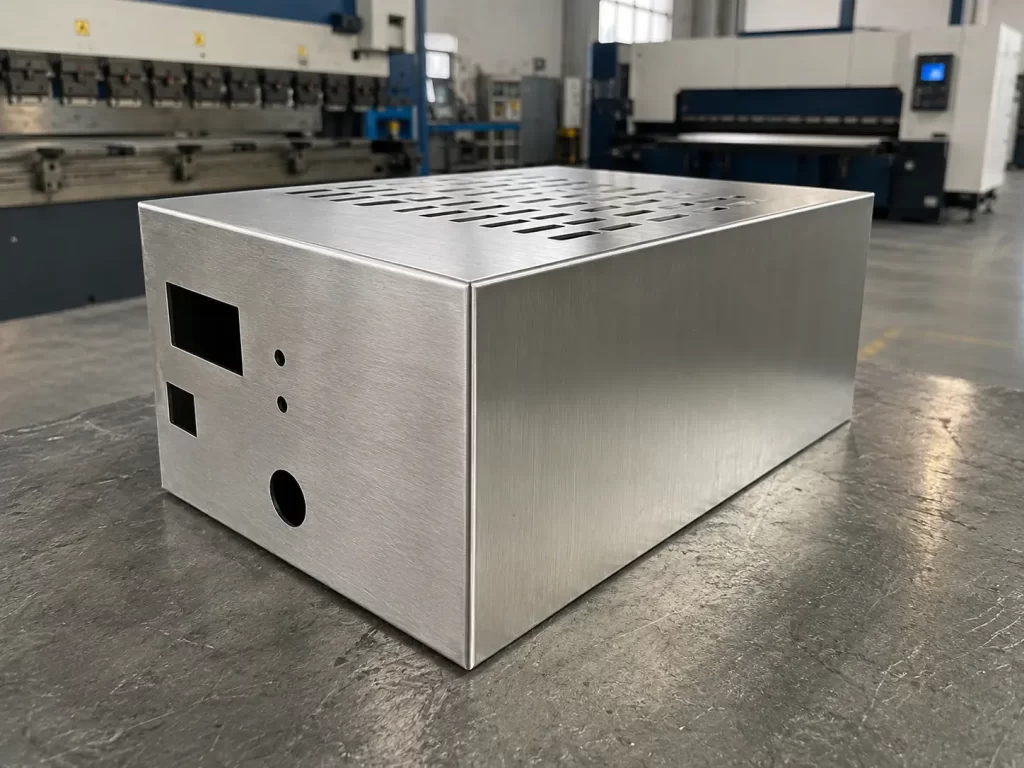
A practical guide for engineers and procurement professionals covering stainless steel grade selection, welding methods, surface finishes, and quality control in custom enclosure fabrication—from design review through volume production.
Custom stainless steel enclosure welding is the process of manufacturing non-standard metal housings through a sequence of laser cutting, forming, welding, and surface finishing operations. Engineers, product developers, and procurement teams typically choose custom fabrication when off-the-shelf enclosures cannot meet specific dimensional, environmental, or aesthetic requirements.
A properly fabricated welded enclosure does more than simply house components. It must also support heat dissipation, provide electromagnetic shielding, meet the required ingress protection rating, and reflect the overall quality of the finished product.
This guide focuses on the key decisions involved in a custom enclosure project:
- How to select the right stainless steel grade
- Which welding process is best suited to the application
- Which design decisions can reduce manufacturing costs without compromising performance
- How to maintain consistent quality from the first prototype to the thousandth production unit
What Is Custom Stainless Steel Enclosure Welding?
Enclosure welding is the process of joining cut and formed stainless steel panels through fusion welding to create protective metal housings, including:
- Enclosures
- Housings
- Cabinets
- Covers
Compared with cast or machined housings, welded sheet metal enclosures offer greater design flexibility, shorter lead times, and lower tooling costs, particularly for low- to medium-volume production.
The typical manufacturing process begins with laser cutting, where flat stainless steel sheets are cut to the required profiles. The blanks then move to CNC press brake forming, where a programmed bend sequence creates the three-dimensional enclosure shape.
Welding follows, joining the formed panels along their seams to create a rigid and, where required, sealed structure.
After welding, the enclosure undergoes:
Post-weld treatment: grinding, cleaning, and passivation
Surface finishing: powder coating, brushing, or electropolishing
Because each operation affects the next, successful enclosure fabrication depends on coordination across the entire manufacturing process rather than treating each step in isolation.
Selecting the Right Stainless Steel Grade for Welded Enclosures
Different stainless steel grades behave differently during welding. The grade selected at the beginning of a project affects:
- Corrosion resistance
- Weld quality
- Post-weld appearance
- Total manufacturing cost
Four grades are commonly used in custom stainless steel enclosure fabrication.
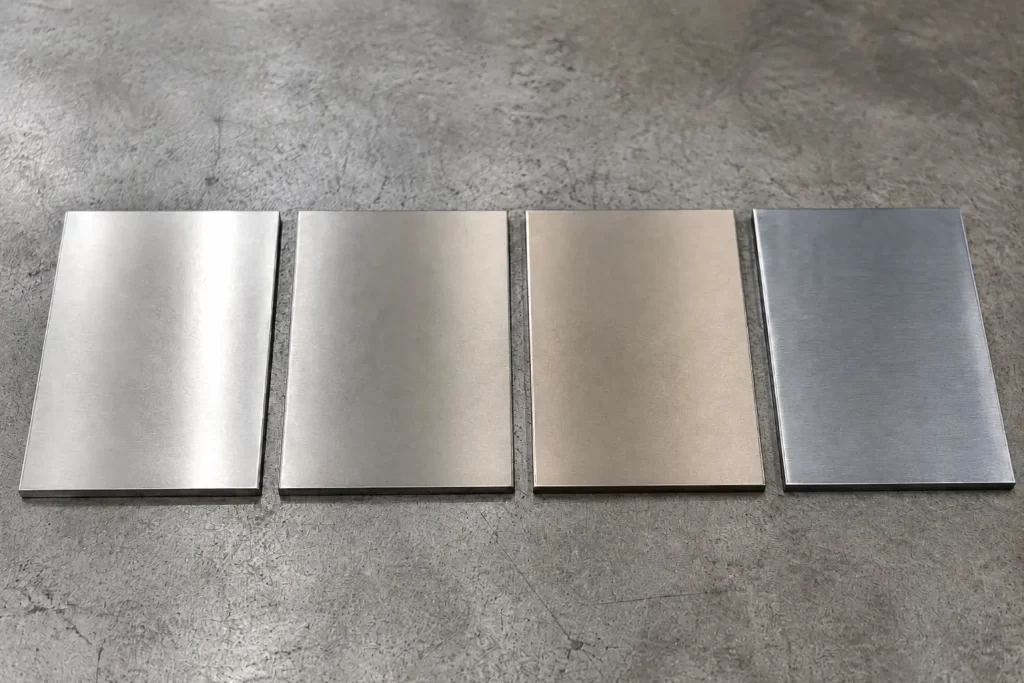
304 Stainless Steel
304 stainless steel is the most widely used grade for welded enclosures.
Its approximate composition includes:18% chromium,8% nickel
It provides good corrosion resistance in most indoor and general industrial environments. Its austenitic structure also gives it excellent weldability, allowing TIG, MIG, and laser welding to produce reliable results under standard process conditions.
For applications that are not exposed to chlorides, acidic chemicals, or marine atmospheres for extended periods, 304 usually offers the best balance of performance and cost.
316 / 316L Stainless Steel
316 and 316L stainless steel contain 2–3% molybdenum in addition to the alloying elements found in 304. This significantly improves resistance to chloride-induced pitting and crevice corrosion.
As a result, 316L is commonly specified for:
- Coastal environments
- Chemical processing plants
- Food-contact equipment
- Medical device enclosures
The “L” designation indicates a low carbon content of no more than 0.03%. This reduces the risk of sensitization, a condition in which chromium carbides form along grain boundaries in the weld heat-affected zone and weaken corrosion resistance.
For welded enclosures that must meet demanding hygiene or corrosion-resistance requirements, 316L is generally preferred over standard 316.
201 Stainless Steel
201 stainless steel replaces part of the nickel content with manganese and nitrogen, reducing material cost.
It is suitable for:
- Indoor environments
- Cost-sensitive projects
- Applications with modest corrosion-resistance requirements
However, 201 is more difficult to weld consistently. Its higher manganese content may increase spatter and make weld-pool behavior less predictable, particularly during TIG welding.
It is rarely the best choice for enclosures exposed to moisture, chemicals, or outdoor weather conditions.
430 Stainless Steel
430 stainless steel is a ferritic grade with magnetic properties and moderate corrosion resistance.
Compared with austenitic stainless steels, it has poorer weldability. The heat-affected zone can become brittle, and post-weld cracking may occur unless suitable preheating procedures and filler materials are used.
430 is occasionally specified for:
- Decorative enclosures
- Applications requiring magnetic compatibility
However, it requires greater engineering attention during welding.
Comparing TIG, MIG, and Laser Welding
| Factor | TIG (GTAW) | MIG (GMAW) | Laser Welding |
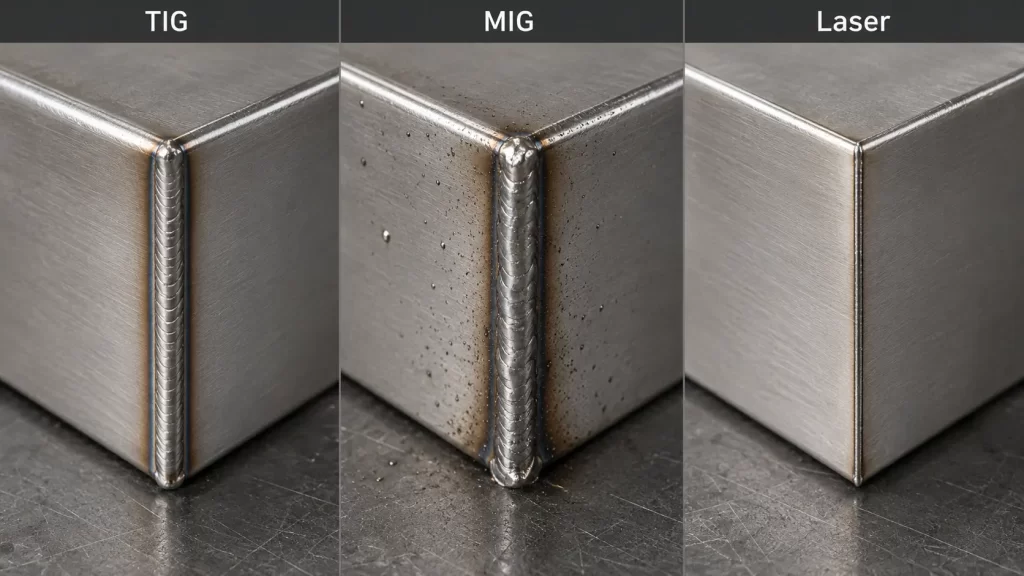
| Weld appearance | Excellent—smooth, uniform weld bead | Moderate—wider bead with more spatter | Excellent—narrow, clean weld bead |
| Speed | Slow | Fast | Moderate to fast |
| Typical material thickness | 0.8–3.0 mm | 1.5–6.0 mm | 0.5–2.0 mm |
| Distortion risk | Low to moderate | Moderate | Very low |
| Skill requirement | High | Moderate | Low, with machine-guided operation |
| Best suited to | Visible seams, thin walls, precision parts | Structural seams, thicker panels, production runs | Thin walls, high cosmetic standards, minimal distortion |
For enclosures that combine visible exterior surfaces with internal structural joints, a hybrid welding strategy is often the most effective:
- Use TIG welding on exposed seams to achieve a cleaner appearance
- Use MIG or laser welding on internal or concealed joints to improve speed and control cost
Post-Weld Surface Finishing Options
Surface Finish Comparison
| Surface Finish | Appearance | Welding Requirements | Typical Applications |
| Powder coating | Uniform color, matte or semi-gloss | Welds must be ground smooth and free of spatter | Industrial equipment, electronics, general-purpose enclosures |
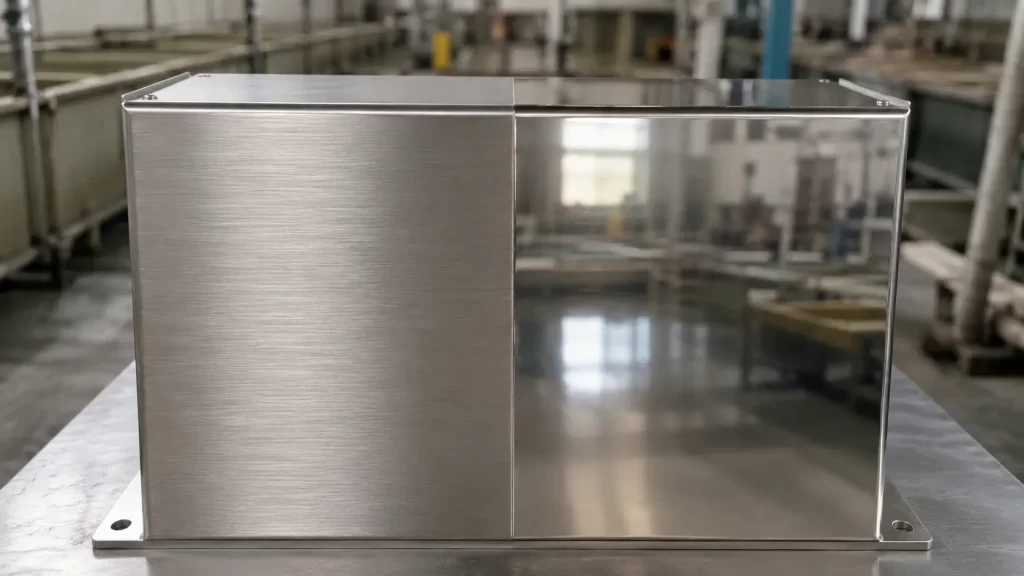
| Brushed finish, No. 4 | Directional satin texture | Heat tint must be completely removed before brushing | Consumer electronics, medical equipment, premium machinery |
| Electropolishing | Bright, highly smooth, mirror-like surface | Welds must be consistent and free of undercut or porosity | Pharmaceutical, food-processing, and semiconductor equipment |
| Passivation | No visible cosmetic change; restores corrosion protection | Oxides and free iron must be removed from the heat-affected zone | All welded stainless steel enclosures |
| Sandblasting | Uniform matte, lightly textured finish | Can tolerate minor weld-surface imperfections | Industrial equipment and outdoor housings |
Common Applications Across Industries
Requirements for welded stainless steel enclosures vary significantly by industry.
Medical equipment housings prioritize cleanability and material traceability, while power-electronics enclosures place greater emphasis on thermal management and ingress protection.
| Industry | Enclosure Type | Typical Grade and Thickness | Welding Method | Key Quality Priorities |
| Industrial automation | PLC cabinets, VFD housings | 304, 1.5–2.0 mm | TIG or MIG; stitch or continuous welding | Dimensional accuracy for PCB and heat-sink mounting; IP54 or higher |
| Telecommunications | Base-station housings, server cabinets | 304/316, 1.0–1.5 mm | Laser or TIG welding with minimal distortion | EMI shielding, thermal management, batch consistency |
| Medical equipment | Surgical equipment, diagnostic instruments | 316L, 1.0–2.0 mm | TIG welding with argon back purging | Surface roughness of Ra ≤ 0.8 μm, hygienic geometry, full traceability |
| Food processing | Food machinery housings, packaging equipment enclosures | 316L, 1.5–2.0 mm | TIG welding with continuous hygienic seams | Crevice-free construction, food-grade finish, resistance to cleaning chemicals |
| Renewable energy and power | Inverter housings, BMS enclosures, distribution cabinets | 304, 1.5–2.5 mm | MIG or TIG welding with IP65 sealing | Thermal design, electrical grounding, IP65 or higher |
| Security and outdoor equipment | Camera housings, access-control enclosures | 316, 1.0–1.5 mm | Laser or TIG welding with sealed joints | Weather resistance, UV-stable finish, waterproof sealing |
Understanding these industry-specific requirements during the quotation stage—not after production has started—is one of the key differences between a reliable enclosure supplier and one that delivers parts requiring rework.
FAQ
What is the difference between 304 and 316L stainless steel for welded enclosures?
304 stainless steel is suitable for indoor and general industrial environments and usually provides the best overall value.
316L contains molybdenum, giving it greater resistance to chloride corrosion. It is better suited to marine, chemical, food-processing, and medical applications. The low-carbon “L” grade also reduces the risk of sensitization in the weld heat-affected zone.
Which welding process is best for stainless steel enclosures?
The best process depends on material thickness and appearance requirements.
TIG welding produces the cleanest welds and is well suited to thin material and visible surfaces. MIG welding offers the highest production speed and is suitable for thicker panels and structural joints. Laser welding provides the lowest heat input and is ideal for thin-wall, high-precision enclosures.
Many projects use a combination of these processes.
What stainless steel thickness is commonly used for enclosure fabrication?
Most stainless steel enclosures are manufactured from material between 1.0 and 2.0 mm thick.
Material below 1.0 mm generally requires TIG or laser welding to reduce the risk of burn-through. Material above 2.0 mm provides greater rigidity but increases material cost and forming requirements.
How can welding distortion be prevented in thin stainless steel enclosures?
Common distortion-control methods include:
- Using copper backing bars to dissipate heat
- Holding the enclosure in dedicated welding fixtures
- Dividing long welds into shorter sections
- Using a low-heat-input welding process
The welding sequence and process parameters should be established during the prototype stage and documented for production.
Which surface finishes are available after welding?
Common options include:
- Powder coating: durable and available in a wide range of colors
- Brushed finishing: creates a directional satin appearance
- Electropolishing: produces an ultra-smooth, highly corrosion-resistant surface
- Passivation: restores the protective chromium oxide layer
The required surface finish should be confirmed before welding begins so that the welding method and post-weld treatment can be properly coordinated.
Ready to Start Your Custom Stainless Steel Enclosure Project?
Send us your CAD files or drawings for a manufacturing assessment and quote.
Please include the following information:
- Material grade
- Wall thickness
- Welding requirements, including weld type, seam location, and sealing requirements
- Surface finish, such as powder coating, brushing, electropolishing, or passivation
- Tolerance requirements for critical dimensions
- Target quantity and delivery schedule
- Application environment, such as indoor, outdoor, food-contact, or medical use
- Packaging requirements, including surface protection, stacking method, and shipping method
